Most black holes need a star to die first. A massive star collapses, the core implodes, and a black hole is left behind. That is the version we are most aware of. It is well understood, well observed, and backed by decades of data. But that is not the only kind of black hole. There is one that doesn’t need a star to die: a primordial black hole. It just needed a moment of chaos after the Big Bang. Depending on who you ask, you may hear all kinds of answers about what is a primordial black hole: invisible, ancient, and possibly the answer to one of the biggest unsolved problems in all astronomy. One of the biggest reasons why it’s unsolved is that it’s hypothetical. I will get back to this later, but essentially, we think it’s there with strong arguments, but we never saw or detected one.
I have talked a lot about black holes from supermassive to “normal” black holes, how they form, what is a black hole, and many more. But they are almost exclusively focused on the most traditional black holes, similar to one another, and those we are sure of through observation or some form of detection. This time, I want to focus on something more controversial: what a primordial black hole is, the different one. How did they form, how big they are, what our thoughts are, their connection to dark matter, and so on.
Note: Some pictures in this post have been generated with the help of AI (Large Language Models).
What is a Primordial Black Hole?
A primordial black hole is a hypothetical type of black hole that did not form from a dying star. Instead, it formed directly from extreme density fluctuations in the very early universe, within the first fraction of a second after the Big Bang. It is one of the oldest possible objects in existence, and unlike the black holes we regularly observe and confirm, we have not yet directly detected a primordial black hole. That word “hypothetical” does not mean the idea is weak. Institutions like NASA, ESA, and research groups at universities around the world take it seriously and conduct further research. It simply means we have not yet found definitive proof of one, but as you will see later, we are getting closer.
The difference from a normal black hole is simple in one sense and huge in another. A normal black hole forms when a massive star runs out of fuel and collapses. A primordial black hole formed before any star existed, from conditions that no longer exist anywhere today. From afar, they (probably) look similar, but their origins are completely different. You can read about how a traditional black hole forms in my previous articles.
How Did They Form?
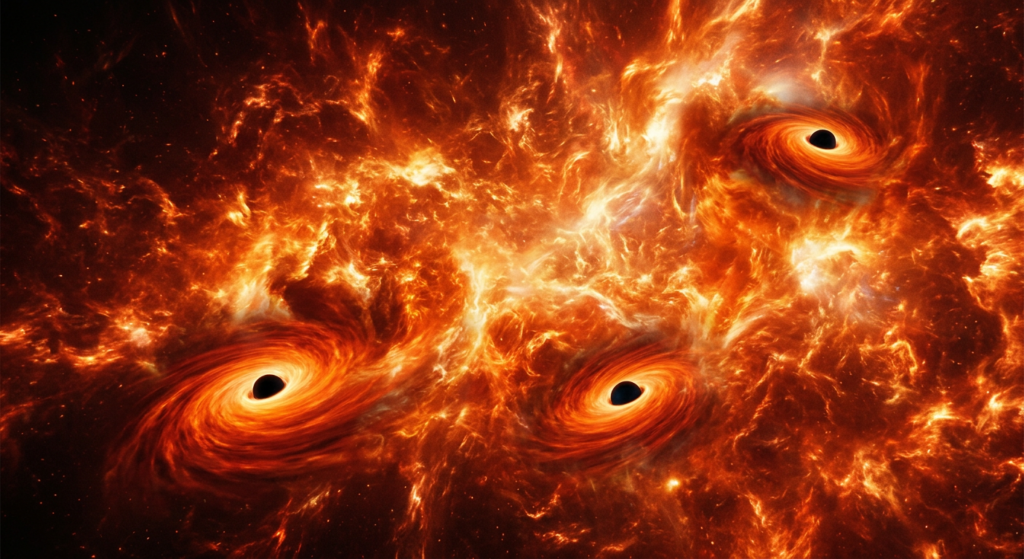
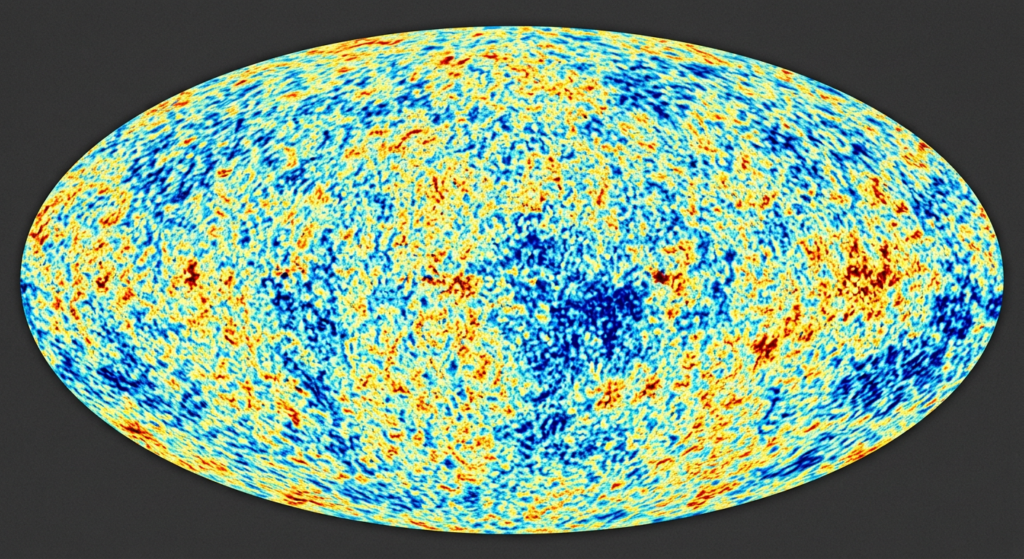
Picture the early universe (seconds, moments after the Big Bang): it was a hot, dense place. It was full of variations in density, and those variations made the universe unstable and irregular. Although they smoothed out as the space expanded and things cooled, that brief period was enough for gravity to take over before expansion. That irregularity, in theory, created the primordial black holes. Think of a rising bread dough, most of it expands evenly and smoothly, but there are denser patches that behave differently. The early universe had the same unevenness, but on an extreme scale. There were extremely dense and compressed regions.
In those densest regions, gravity pulled matter inward faster than expansion could scatter it. That collapse could create a black hole before any star had ever formed. It’s sort of like when a star dies and forms a black hole. But in this case, it was the universe itself (those dense patches) that collapsed inward, with gravity winning and creating a black hole from nothing.
How Big Can Primordial Black Holes Get?
Primordial black holes, since they are theoretical, can be enormous in size. The theory allows for it, and there is a huge range. Some could be incredibly tiny, with the mass of a mountain squeezed into a space smaller than an atom. Others could be far larger, even thousands of times the mass of the Sun, depending on the density of the region that formed them.
As you may already understand, a primordial black hole is not limited by the same stellar rules that shape ordinary black holes. Its size depended on the density of the early patch that collapsed, so the possible range is large. If the dense patch the black hole formed in wasn’t too dense, then the size could be very small, but if the patch was massive, then the size would be extreme. One of the reasons why primordial black holes are a theory. If they can be as small as an atom (or any size for that matter), how are we going to find and distinguish them?
Remember, we are in theoretical territory. We are not talking about a cataloged population with tidy measurements. We are talking about a class of objects that could exist in several different mass windows, some of which are much more plausible than others.
The Mass Range We Focus On
Since we have such a massive range, you have to focus your attention somewhere. You can’t just look at every single thing you observe and see if they are a primordial black hole. You need to be strategic. The most interesting range right now is around asteroid mass (roughly 10^17 to 10^23 grams). Primordial black holes in that zone could exist, and they are especially relevant to dark matter discussions because they are hard to detect and could be numerous enough to matter.
This is the sweet spot where observers are focusing the most attention. Anything much smaller would likely have evaporated long ago. Anything much larger starts to behave more like a traditional compact object that should have shown more clearly in surveys.
Could Primordial Black Holes Be Dark Matter?
Dark matter is one of the biggest mysteries in astronomy. We know it is there because of gravity, but we do not know what it is; we have never detected it, and we don’t have direct or indirect evidence. Similar to primordial black holes. However, primordial do not require any new particle physics at all. They are ordinary black holes in an extraordinary place and time. Many people think or consider that primordial black holes may be dark matter or may have dark matter in their substance. We don’t know what dark matter is made of, so it’s even a question whether it may be dark matter itself. I also explored the connection between dark matter and normal black holes in a separate article (which is/was a valid theory), and we always search for dark matter through dark matter experiments. No luck so far. Maybe this can bring that luck?
The Case For
Primordial black holes fit dark matter in a very simple way: they are dark, they do not shine, and they interact mainly through gravity. That makes them a natural fit for something we only detect by its gravitational effects. Interest rose again after LIGO detected gravitational waves from merging black holes in 2015. Some of those masses looked suspiciously high for ordinary stellar remnants, which made primordial origins worth a fresh look. But so far, there is no definite proof for the “case for.” It’s still open, we are still looking, but the theory and thought behind it match well.
The Case Against
First of all, we don’t even know if primordial black holes are real. If they are real and our theories are correct, then our evidence in these theories is not clear and good enough. Microlensing surveys and observations of the cosmic microwave background have ruled out huge swaths of parameter space. That means primordials may still exist in some mass windows, but they probably cannot explain everything on their own.
Hawking Radiation: Why Small Ones May Already Be Gone
According to Stephen Hawking’s Hawking Radiation theory, black holes slowly emit radiation and lose mass over time (that’s how a black hole dies on extraordinary timescales). That means smaller black holes evaporate faster than larger ones. So with this mindset, the small primordial black holes (eg, the ones that are the same size as an atom) are already gone. Of course, we assume that the primordial black holes are real, and there are small ones. This is an important thought process because, similar to how we look for primordials, we can simply have a size limit and look for things that are above that limit. Any object below that threshold would have disappeared long ago, and we can perhaps look for subtle traces in the early universe instead of the exact object.
For example, in 2025, researchers proposed that we should look for positron spikes that these dead small primordial black holes could cause when they pass through the inner solar system. The Alpha Magnetic Spectrometer aboard the International Space Station could, in principle, help spot this signature. More on that idea appears in NASA’s and the AMS-02 positron constraints published in Physical Review D.
How Are Scientists Looking for Them?
Because no primordial black hole has been confirmed yet, detection is the heart of the story. Researchers are using several different methods, and each one is aimed at a different possible mass range or behavior pattern.
Gravitational Microlensing
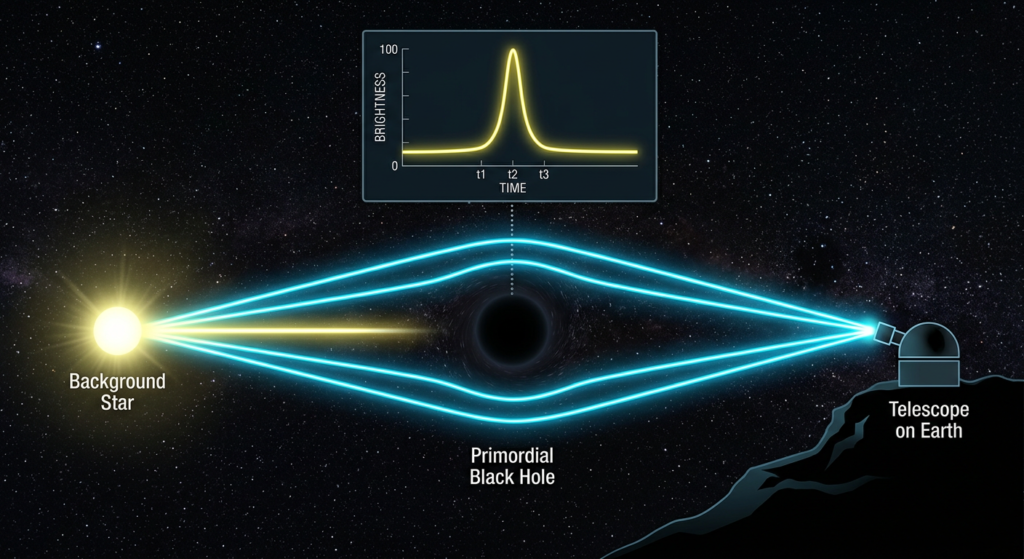
If a PBH passes between us and a background star, it can bend the star’s light and make the star briefly brighter. That is called microlensing. It is one of the most established ways of looking for compact invisible objects in the galax and one of the most frequent methods of looking for something (similar to primordials) in the universe. It gives us solid indirect evidence, but the challenge is differentiating what bends the star’s light. Primordial black hole? Dark matter? Anything else? For the lensing side, see gravitational lensing and dark matter.
Hawking Radiation Signatures
I already mentioned Hawking radiation and its approach. But this should be here, too, because it’s a solid approach. You basically look for the particles a tiny evaporating primordial black hole might emit. Recent research suggests this could be done with gamma rays or positrons, especially if a black hole passes close enough for the signal to stand out. This is a tricky search, but it is one of the most promising for the small PBHs that might still exist today (that haven’t evaporated completely).
Gravitational Wave Fingerprints
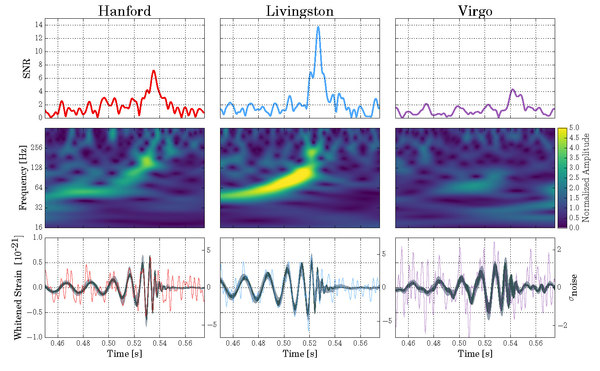
If primordial black holes form binaries and merge, they should produce gravitational waves. LIGO and Virgo saw some of these black hole mergers, and the masses looked a bit unusual in those mergers when we compare them with standard stellar models. That started the debate. That does not prove a primordial origin, but it keeps the idea in play.
Why Does Any of This Matter?
Primordial black holes matter because they sit at the intersection of three huge questions: how the universe began, what dark matter is, and how the first structures in the cosmos formed. That is a lot for one hypothetical object to carry, which is part of why the topic gets so much attention. If they exist in the right numbers, they could help explain why galaxies formed the way they did and why the universe’s hidden mass is still hidden. If they do not exist, that is also useful, because it helps narrow the search for dark matter and pushes cosmologists toward other answers.
They Could Solve the Dark Matter Problem
It’s no surprise that we don’t know dark matters. We don’t know what they are made of, we don’t know what they are. We don’t even know for sure if they exist (in the form we imagine them). So, if primordial black holes make up even part of dark matter, that would be huge. It would mean one of the greatest mysteries in physics could be explained without introducing a brand-new particle. Sometimes the simplest answer is also the most surprising one. That is why they keep showing up in serious papers, not just popular science discussions. Researchers are still testing the idea because the stakes are enormous.
They Could Explain Supermassive Black Holes
Supermassive black holes are extremely large black holes that sit at the center of every large galaxy. Ours has one, too. We understand black holes in general, including supermassive ones. However, we still don’t completely understand how some of these supermassive black holes have gotten to their sizes so early in the universe’s age. There shouldn’t have been enough time for them to be created and grow to this size. Because for a black hole to grow (even supermassive black holes), they need to emit things, basically eat things floating around the universe. Primordial black holes could have acted as seeds, giving galaxy centers a head start and letting them grow over time.
New Webb results from ESA and NASA have made that question even more interesting, because some black holes appear to have formed before their galaxies fully assembled. The ESA Webb finding a black hole before its galaxy is a great example of the possibilities this may bring.
Conclusion
The majority of black holes form when a star above a certain mass dies. A star lives its life, dies, and a black hole emerges from that. This process takes time, so black holes shouldn’t have existed from the early days of the universe. But, as is the case in many things in astronomy, that’s probably not the case. We have a different type of black hole called primordial black holes that probably skipped that step entirely. According to the calculations and theories, these black holes may have formed in the first second of the universe, right after the Big Bang. Before stars, before atoms, before almost anything existed.
We do not have direct or indirect evidence yet, but the search is alive, and there are many theories backing this. If we can detect and observe one, they could answer so many questions. Are they dark matter? Or part dark matter? How did they form so early in the universe? Can black holes form in a different way than we know? We are looking for these black holes through microlensing, telescopes, Hawking radiation, and many other ways. If primordial black holes exist in the right numbers, they could be part of dark matter, part of the origin story of galaxies, and part of the reason the early universe became structured at all. So, primordial black holes are black holes that formed in the first seconds of the universe, and that could hold a lot of answers.
FAQ
What is a primordial black hole in simple terms?
A primordial black hole is a black hole that formed in the very early universe from an extremely dense region of space, not from a collapsing star.
Have primordial black holes been discovered?
Not yet with certainty. There are hints and active searches, but no direct confirmed detection.
Could primordial black holes be dark matter?
Possibly in some mass ranges. They are one of the strongest dark matter candidates, but they probably cannot explain all of it.
What size can primordial black holes be?
They could theoretically range from extremely tiny objects with asteroid-like mass to black holes far more massive than the Sun.
What is the difference between a primordial black hole and a regular black hole?
Primordial black holes formed in the first seconds of the universe from the dense patches that the density fluctuations created in those first seconds. It’s theoretical and highly unusual. Regular black holes form when massive stars die and collapse.