The universe is a chaotic place; a lot of violet things happen. Black hole formations, stars dying, and many more. Two of those violet events are supernova and hypernova. But what is the difference between hypernova vs supernova? Aren’t they the same thing? Yes and no. They both happen because a star dies. However, the difference is in how big and violent they are when they happen.
When a star dies, depending on its size, it either explodes as a supernova or a hypernova. A supernova can outshine its entire host galaxy when it happens, and it lasts a few weeks. It’s not extremely rare; it happens in the universe rather frequently. But a hypernova is bigger. The same thing happens; a massive star reaches the end of its life, but it is one of the most energetic phenomena we can observe from Earth, the gamma-ray burst. It’s a massive explosion, ten times bigger than a supernova (yes, ten times bigger than an explosion that outshines an entire galaxy). It is way rarer than a supernova.
In addition to the differences between hypernova vs supernova definition, what triggers each of them, how their energy and aftermath differ, and why does only hypernova fire off a beam of radiation across billions of light-years? Also, did we observe any, and if so, how?
Note: Images in this article have been generated with the help of large language models (LLMs).
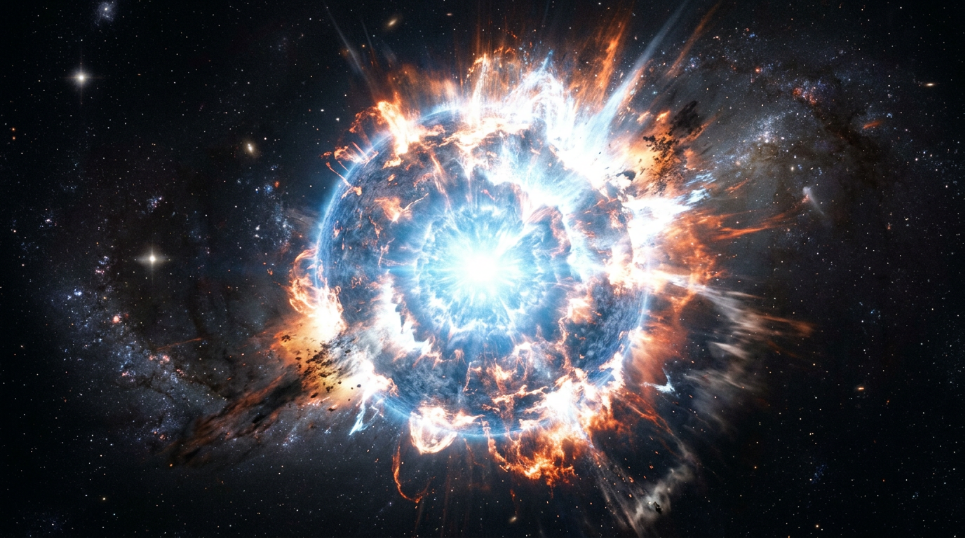
What is a Supernova?
A supernova is the explosive death of a star. It happens in one of two ways: either a massive star runs out of nuclear fuel and its core collapses under its own gravity, or a white dwarf in a binary system pulls in enough matter from a companion to trigger a runaway thermonuclear reaction. Either way, the result is the same: a sudden, catastrophic release of energy that can briefly outshine an entire galaxy. They are not theoretical, we know them, we have been documenting them for hundreds of years.
For example, the 1054 AD supernova was so bright that Chinese and Japanese astronomers recorded it during broad daylight, and its remnants are now what we call the Crab Nebula. In more recent history, SN 1987A, a supernova in the Large Magellanic Cloud, became the closest observed supernova in nearly 400 years and gave astronomers their first real chance to study one with modern telescopes and neutrino detectors working together. NASA continues to track new supernovae regularly using orbiting telescopes that scan the sky for these sudden bursts of light, which is part of why supernovae are so well understood compared to hypernova vs supernova.
The Two Main Types of Supernova
Astronomers generally split supernovae into two families, and the distinction comes down to what kind of star exploded and how. A Type Ia supernova comes from a white dwarf star that has been stealing matter from a companion star in a binary system. As the white dwarf gains mass, it eventually crosses a mass limit of about 1.4 times the mass of the Sun (a threshold called the Chandrasekhar limit) at which point it can no longer support itself against its own gravity, and the whole star detonates in a runaway thermonuclear reaction that destroys it completely, leaving nothing behind.
The other type is a Type II supernova, and it works completely differently. It comes from the core collapse of a single massive star, typically at least 8 times the mass of the Sun, once the star can no longer sustain nuclear fusion in its core. Fusion is what holds a star up against the crushing weight of its own gravity, so once the fuel runs out, the core collapses in well under a second, triggering a rebound shockwave that blows the outer layers of the star apart. The core itself remains behind in a different form.
Every star dies, and its death creates something in the universe depending on its mass and size, which is why even a supernova has two types. Some stars die and form a black hole, some stars stop at a neutron star, and so on.
What’s Left Behind After a Supernova?
The star explodes, becoming a supernova. Is there anything left behind? What remains after a supernova depends heavily on how massive the original star was, and this is where the story starts branching toward the hypernova comparison. A Type Ia supernova leaves nothing behind at all; the white dwarf is completely destroyed in the explosion, scattering its material into space. A Type II supernova is different: if the core that’s left behind after the explosion is below roughly three solar masses, it settles into a neutron star, an object so dense that a teaspoon of it would weigh billions of tons on Earth. Neutron stars are mass bombs, and they get extremely hot. Despite them being hot and dense, neutron stars are not too big. If the leftover core is heavier than that, its own gravity overwhelms even the extreme pressure holding a neutron star together, and it keeps collapsing into a black hole instead.
What is a Hypernova?
A hypernova is an extremely energetic type of core-collapse supernova, triggered when a star with more than roughly 30 solar masses collapses directly into a rotating black hole. The explosion that results is somewhere between ten and a hundred times more powerful than a standard supernova. Astrophysicists sometimes call this process the collapsar model, since the defining feature is the star collapsing all the way down to a black hole rather than stopping at the neutron star stage, the way most Type II supernovae do.
The term itself is relatively new in astronomy. It gained traction in 1998, after we discovered an unusual and unexpectedly bright supernova, SN 1998bw, in the same location and at almost the same moment as a gamma-ray burst, GRB 980425. That supernova was roughly ten times brighter than the typical supernovae of its class. Scientists said that this is not the same as a supernova, we have to categorize this differently, so hypernova term is now here. That first hypernova, SN 1998bw, is still one of the most studied examples to this day, precisely because it was close enough, at around 140 million light-years away, for astronomers to gather detailed data on it.
Why Hypernova Needs Bigger Stars
The 30 solar mass threshold is not an imaginary number we created. The physics tells us that below that point, a collapsing star’s core typically doesn’t have enough gravitational force to go all the way through to a black hole in one continuous process. So, it tends to stall at the neutron star stage instead, because the pressure created by tightly packed neutrons is enough to halt the collapse. Above that threshold, the weight of the collapsing material overwhelms even that resistance, and the core keeps collapsing until it forms a black hole surrounded by a hot, spinning disk of infalling matter.
SN 1998bw is a good example of this again. The researchers who study SN 1998 bw estimate that its progenitor star started at around 40 solar masses and later lost some of its outer layers before the final collapse. We see this pattern in many hypernova candidate stars (known as Wolf-Rayet stars, massive stars that have already blown away much of their hydrogen by the time they explode). This is really the root cause of everything else that separates a hypernova from an ordinary supernova. One extra physical detail (enough mass to skip straight past the neutron star phase) changes the entire outcome.
The Gamma-Ray Burst Connection
This is the detail that makes hypernova genuinely unique when we compare hypernova vs supernova. When the massive star’s core collapses into a black hole, the surrounding material doesn’t fall in evenly. It forms a rotating accretion disk, and the extreme conditions near the newly formed black hole launch narrow jets of material at close to the speed of light because of the intense magnetic fields that the black hole’s rapid spin creates.
If one of those jets happens to point roughly toward Earth, we detect it as a long gamma-ray burst, one of the most energetic electromagnetic events known to exist, capable of releasing more energy in ten seconds than the Sun will release over its entire lifetime. NASA’s Neil Gehrels Swift Observatory was built specifically to catch these bursts within seconds of detection, swinging its onboard telescopes toward the burst location automatically, and has recorded more than a thousand gamma-ray bursts since it launched in 2004.
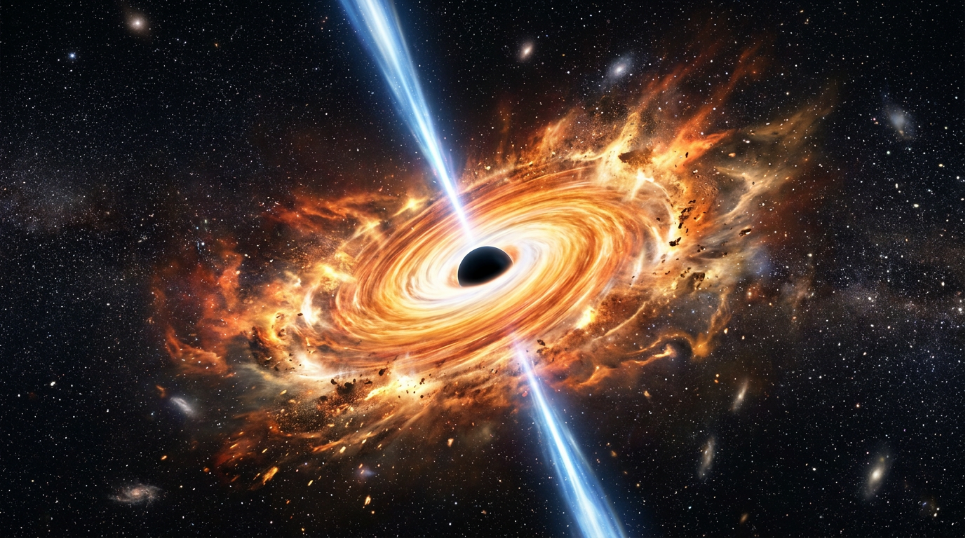
Hypernova vs Supernova: The Core Differences
Both events mark the death of a massive star, and you know by now that the biggest difference is the gap in scale between them. That gap difference creates more differences, though, from the energy released to what gets left behind to whether the explosion ever produces a beam of gamma rays visible from billions of light-years away.
Energy Output
A typical supernova releases somewhere around 10^44 joules of energy in total, most of it in the form of neutrinos and kinetic energy in the expanding debris. A hypernova can release ten to a hundred times that amount. For example, we estimate that SN 1998bw’s just kinetic energy release was roughly 5×10^52 ergs, around ten times higher than a typical core-collapse supernova of its type. To put that in perspective, a hypernova can release more energy in a matter of seconds than the Sun will produce over its entire ten-billion-year lifetime.
Progenitor Star Mass
Supernovae generally come from stars around eight solar masses and above, covering a fairly wide range of stellar types. Hypernovae require something far heavier, roughly 30 solar masses or more at formation. But there is a possibility that the star may have shed a significant portion of that mass as stellar wind before it ever explodes. That difference in starting mass is really the reason other distinctions between them exist at all: it decides whether the collapsing core stalls at the neutron star stage or keeps going all the way to a black hole.
What They Leave Behind
A supernova can leave behind either a neutron star or a black hole, depending on the original star’s mass. It may also leave nothing at all, for example, in the case of a Type Ia explosion. A hypernova, because it comes from such an extreme mass in the first place, almost always results directly in a rotating black hole surrounded by a hot accretion disk, and the neutron star stage doesn’t happen at all.
Comparison at a Glance
Feature | Supernova | Hypernova |
Progenitor star mass | ~8+ solar masses | ~30+ solar masses |
Energy released | ~10^44 joules | 10–100x more than a supernova |
Typical remnant | Neutron star, black hole, or nothing (Type Ia) | Rotating black hole |
Gamma-ray burst? | Rare | Common (long GRBs) |
Frequency | Relatively common | Extremely rare |
Notable example | SN 1987A, SN 1054 (Crab Nebula) | SN 1998bw / GRB 980425 |
Are Hypernovae Actually Rare?
Yes, significantly. Because a hypernova requires a star of at least 30 solar masses, and stars anywhere near that size are already uncommon. So, the pool of stars capable of producing a hypernova is quite small already. On top of that, many of the stars massive enough to qualify lose so much mass through stellar winds over their lifetime that they may not retain enough mass at the moment of collapse to trigger the full hypernova process.
Most of what astronomers know about hypernovae doesn’t come from catching the explosion itself. It comes from catching the gamma-ray burst and working backward. That’s exactly how we found SN 1998bw. The BeppoSAX satellite detected GRB 980425 first, and only afterward did astronomers identify the unusually bright supernova in the spiral galaxy ESO 184-G82. That order of discovery (burst first, supernova second) has been the standard pattern for finding hypernova candidates.
How Astronomers Detect Hypernova vs Supernova
We can typically detect a hypernova in two stages. It starts with an orbiting gamma-ray telescope picking up the initial burst and calculating a rough position in the sky. This usually happens within seconds. Then, ground-based and space-based optical telescopes observe the afterglow, which behaves differently compared to a standard supernova’s light curve. When we compare that hypernova vs supernova process on how we detect them, hypernova is much more unique and harder to detect. In supernovae, since there is much more, it’s easier to pick up the afterglow and remnants. We use more diversified approaches.
Hypernova and Supernova are Similar, but Not Enough
A supernova is already close to incomprehensible for us humans. Imagine a single star outshining every other star in its galaxy combined for a few weeks. A star dies and creates this. A hypernova takes that same basic process, but the shining is much bigger and more incomprehensible. And they are real; we observed one, like SN 1998bw. So when we compare hypernova vs supernova, we are comparing real things and the comparison is mostly on what’s left behind and how. Seeing a real event’s remnants taught us even more about hypernovae. Another difference is that hypernova explosions can end at the neutron star level (meaning, the star dies and turns into a neutron star) or may become a black hole. There are two options. With a hypernova, there is only one ending: a black hole. Every hypernova that happens creates a rotating black hole.
FAQ
What is the difference between a hypernova and a supernova?
A supernova comes from a star of roughly eight solar masses or more, reaching the end of its life. A hypernova comes from a much more massive star, at least around 30 solar masses. Then releases ten to a hundred times more energy. It almost always collapses directly into a black hole rather than stalling at the neutron star stage.
How rare are hypernovae?
Very rare. They need stars above roughly 30 solar masses (which are also very rare) that have retained enough mass by the time they collapse so that they trigger a hypernova process. For reference, in that rare chunk of stars above 30 solar masses, only a fraction of those stars retain enough mass by the time they collapse.
Can a hypernova destroy Earth?
Only if it happened close enough to us, which is extremely unlikely given how far away any star massive enough to produce one currently is. The nearest known hypernova candidate, linked to GRB 980425, was still around 140 million light-years away.
Do hypernovas always produce black holes?
Yes, based on our current models and observed examples like SN 1998bw. You have to understand that a hypernova generates an extreme mass. So, that means that the core is so heavy that it collapses directly into a rotating black hole surrounded by an accretion disk.