Every time you research how far a star or a galaxy is, you hear that it’s some light years away. Have you ever wondered how far that really is? Some are millions of times farther from Earth than anything in our Solar System, and we use a special unit called a light year to measure these distances. If you are not an expert, it may be hard to grasp how far 5 light year is.
Despite its name, a light year does not measure time. It measures distance. One light year is the distance light travels in one year (approximately 9.46 trillion kilometers or 5.88 trillion miles). That is an almost impossible distance to imagine. To put it into perspective, light could travel around Earth more than 236 million times in just one year. Astronomers use light-years to describe the distances between stars, nebulae, and galaxies, making it easier to map our universe and understand how far things are.
Note: I used publicly available AI language models to generate images for this blog post.
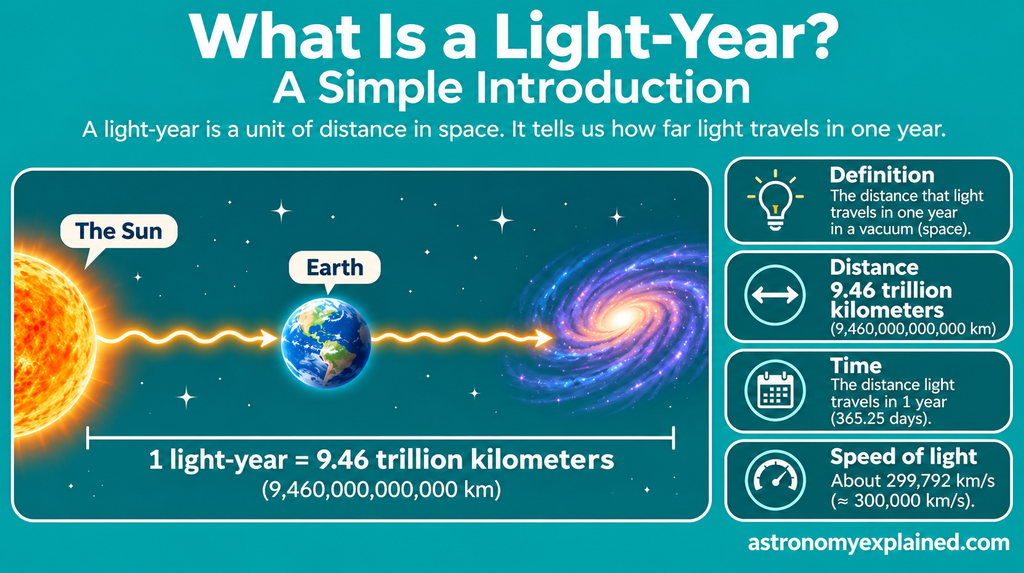
What Is a Light Year?
A light-year is the distance that light travels through a vacuum in one year. It is one of the most common units astronomers use to measure distances beyond our Solar System. Light moves through a vacuum at approximately 299,792 kilometers per second (186,282 miles per second). That means it can travel almost 300,000 kilometers before you can even blink. Now imagine light continuing at that speed for an entire year. The distance it covers is one light year. The exact value is approximately 9,460,730,472,580 kilometers, or about 5.88 trillion miles. We usually round this to 9.46 trillion kilometers because the exact number is rarely necessary for everyday astronomical explanations.
Why Is a Light Year a Measurement of Distance, Not Time?
The name can be confusing. After all, a year is a unit of time, so why does a light year measure distance? Or why did we name it “light year”? Think about how you measure the distance between two cities. You could describe the distance in kilometers, but you could also say how long it takes to drive there. The first tells you how far apart the cities are, while the second tells you how much time the journey takes.
A light year works similarly. It describes how far light travels during a specific amount of time. The year tells us how long light travels, while the resulting number tells us the distance it covers. For example, if a star is four light years away from Earth, it means light from that star takes approximately four years to reach us. It does not mean the star is four years old. However, when the light first reaches us, we see how the star was four years ago.
It’s kind of interesting because we are practically looking into the past of almost everything we see in the universe, especially those that are really far away. Some structures are 100 million of light years away from us. This means, when we look at them, we see how they were 100 million years ago. If an observer 100 million light-years away could somehow observe Earth in enough detail, the light reaching them today would show our planet as it was around 100 million years ago, when dinosaurs still lived here.
How Far Does Light Travel in One Year?
The light year calculation is pretty straightforward. You multiply the speed of light by the number of seconds in a year. The formula is:
Distance = Speed × Time
Light travels approximately 299,792 kilometers every second. A Julian year has 365.25 days (standard calendar for this calculation) or 31,557,600 seconds. When we multiply these values, we get approximately:
299,792 km/s × 31,557,600 seconds = 9.46 trillion kilometers
How Big Is One Light Year?
Now that we know what a light year means, let’s try to understand just how far it is. One light-year equals approximately 9.46 trillion kilometers. That is 9,460,000,000,000 kilometers. Even writing the number makes it difficult to understand its scale (hard for me to write it, too). To make things easier, we can compare a it with distances we are more familiar with, such as the distance between Earth and the Sun.
The distance between Earth and the Sun is 0.0000158 light-years, so it takes roughly 8 minutes for the light from the Sun to reach Earth. Since this distance is used quite commonly and is a distance we know very well, astronomers created another distance scale to use, which is called the astronomical unit (AU). 1 AU is the distance between Earth and the Sun. Here are some useful conversions to see how many kilometers and miles are in a light year:
Measurement | Distance |
Kilometers | 9.46 trillion km |
Miles | 5.88 trillion miles |
Astronomical units | 63,241 AU |
An astronomical unit (AU) is approximately 149.6 million kilometers. In other words, light travels more than 63,000 times the Earth-Sun distance in one year. AU is used for smaller distances, and the light year is used for much bigger distances because saying “63,241 AU” for one light year is not really ideal.
How Long Would It Take to Travel One Light Year?
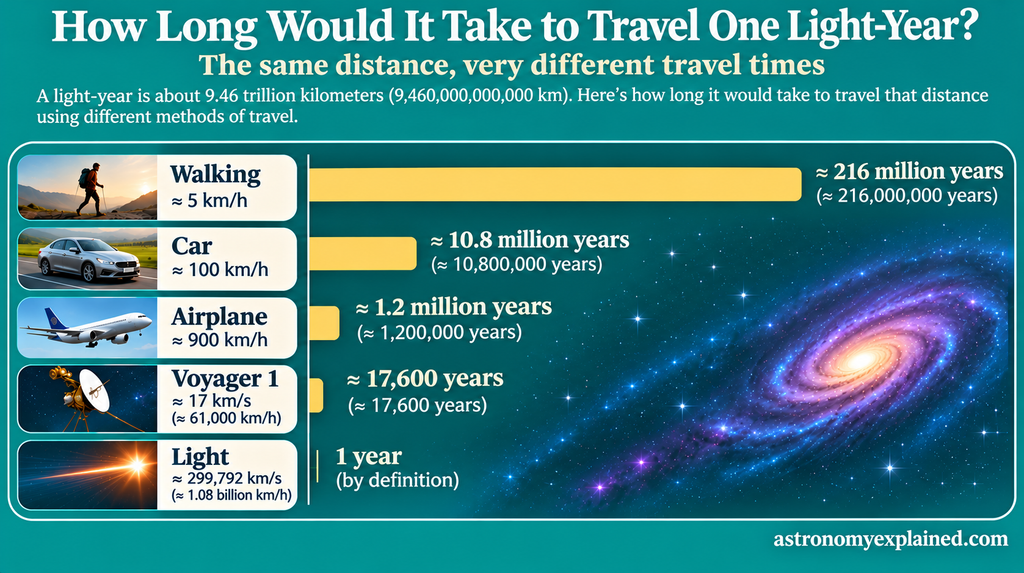
If you want to travel exactly one light year in space, by traveling at the speed of light, it will take you one year. However, according to Einstein’s theory of special relativity, an object with mass cannot reach the speed of light in a vacuum. If we take a range we are more familiar with, a modern jet’s typical flying rate, 900km/h, then it would take you 1.2 million years. It’s a lot, isn’t it? I made a fun comparison of how long it would take by different forms of transportation:
Method of travel | Approximate time to travel one light-year |
Walking at 5 km/h | 216 million years |
Driving at 100 km/h | 10.8 million years |
Flying at 900 km/h | 1.2 million years |
Traveling at 17 km/s | 17,600 years |
Traveling at the speed of light | 1 year |
These are simplified calculations using constant speeds. They do not account for acceleration, stops, or the practical difficulties of traveling through space (like how you can’t walk in space). The spacecraft example uses a speed of roughly 17 kilometers per second, close to Voyager 1‘s speed. Even at that speed, travelling for just one light year would take thousands of years. And remember, Proxima Centauri, the closest star to our Solar System, is more than four light years away. This is why traveling between stars is so difficult. Even Voyager 1 would need thousands of years to cover distances that light can travel in just a few years.
Why Do Astronomers Use Light Years?
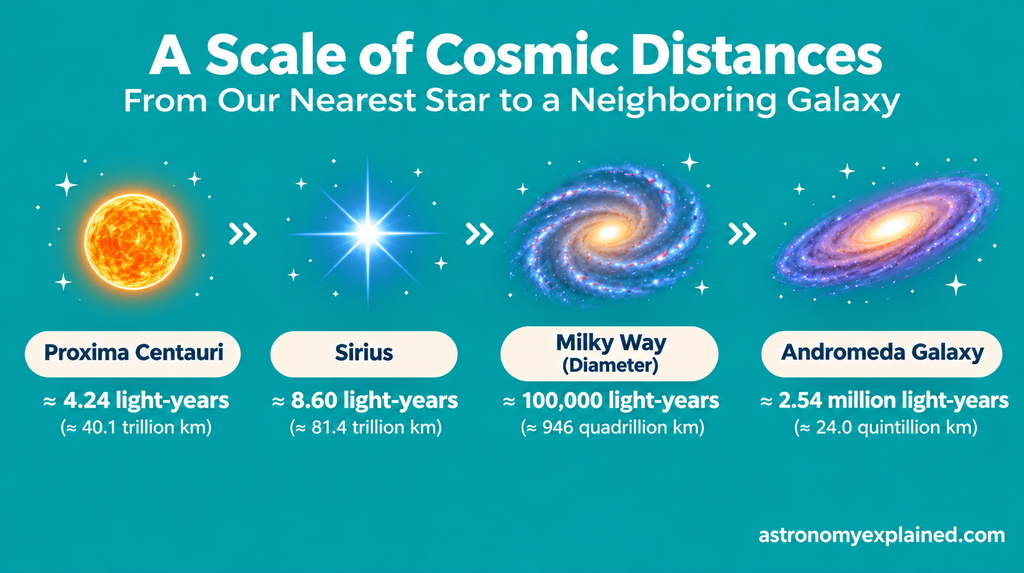
Is there a reason why astronomers use this specific type of measurement method instead of the universal way to do it in kilometers? Yes, and the answer is straightforward: space is incredibly large. Imagine describing the distance between Earth and the nearest star in kilometers. You would need to write a number with more than 13 digits. And that is just the distance to our closest stellar neighbor. For stuff in space farther than that, the distances get enormously bigger. Using this measuring unit makes these distances easier to communicate and compare. Instead of saying that a star is around 40 trillion kilometers away, astronomers can simply say it is about 4.24 light-years away. With this, you immediately know we are seeing 4.24 years into the past of that star, and it takes light 4.24 years to travel.
How Far Away Are Other Stars?
Our Sun is the closest star to Earth, and we already covered how far that is: 1 AU. The next closest star is Proxima Centauri, which is approximately 4.24 light-years away. So if we wanted to travel to it, it would take us 4.24 years at the speed of light. For anything slower than that, we are looking at thousands or millions of years. But Proxima Centauri is not the only star relatively close to us. Here are a few other examples:
Star | Approximate distance from Earth |
Proxima Centauri | 4.24 light-years |
5.96 light-years | |
8.6 light-years |
These distances might seem small compared with the size of the universe, but they are enormous when we consider how long it would take to reach them. For example, Sirius is more than twice as far away as Proxima Centauri. Its light takes approximately 8.6 years to reach Earth.
How Far Away Are Galaxies?
Distances look a bit like “meh” when we check the stars. Things get more interesting, and distances look more impressive when we look beyond the individual stars. Our home galaxy, the Milky Way, is approximately 100,000 light-years across. That means light would need around 100,000 years to travel from one side of the galaxy to the other, assuming a straight path across its full diameter. The Andromeda Galaxy, our nearest large neighboring galaxy, is approximately 2.5 million light-years away. Its light takes around 2.5 million years to reach us.
There are also many more distant galaxies. Some of the galaxies observed by powerful space telescopes are billions of light years away. Their light began traveling towards us billions of years ago, long before humans existed. And now, we are seeing them as they were billions of years ago. Who knows, maybe some sort of life emerged there already, but that version hasn’t reached us.
How Does a Light Year Let Us Look Back in Time?
As I already mentioned, light does not reach us instantly. Even though it travels incredibly fast, it still needs time to cross the enormous distances between celestial objects and Earth. For example, the Sun is approximately 150 million kilometers away from Earth. Since light travels at around 300,000 kilometers per second, sunlight takes about 8 minutes and 20 seconds to reach us. This means that when you look at the Sun, you are seeing it as it was roughly eight minutes ago. The same idea applies to every other object in space. The farther away something is, the longer its light takes to reach us.
What Does It Mean When a Star Is 100 Light Years Away?
Imagine that astronomers discover a star located 100 light-years from Earth. This means the light we see from that star today began traveling towards us approximately 100 years ago. We are observing the star as it appeared a century ago. The star might have changed during that time. Its brightness, size, or other properties could be different today, but we cannot see those changes until the newer light reaches us. This is not because telescopes are slow or because there is a delay in their technology. It is simply how light travels through space.
Light Years vs Astronomical Units vs Parsecs
Light-years are useful for measuring distances between stars and galaxies, but they are not the only units astronomers use. You already learned about the Astronomical Unit (AU) when we discussed the distance between the Earth and the Sun. There is also a third way, called parsecs. Each of these units is used for different purposes and is good for different ranges.
What Is an Astronomical Unit (AU)?
An astronomical unit, usually shortened to AU, is the average distance between Earth and the Sun. One AU is about 149.6 million kilometers. This unit is mainly applicable for distances within our Solar System. For example, Earth is approximately 1 AU from the Sun, while Neptune orbits at an average distance of about 30 AU.
What Is a Parsec?
A parsec is another unit of astronomical distance. Its name comes from the words “parallax” and “arcsecond“. Parallax is the apparent change in an object’s position when we observe it from two different viewpoints. Astronomers use this effect to measure the distances to nearby stars. A parsec is defined as the distance at which one astronomical unit would appear to span an angle of one arcsecond. One parsec equals approximately 3.26 light-years. Although light-years are more familiar to many people, professional astronomers use parsecs quite frequently when describing stellar distances.
Which Unit Do Astronomers Use?
Here is a simple comparison of the three units:
Unit | Approximate distance | Common use |
Astronomical unit (AU) | 149.6 million km | Distances within the Solar System |
Light-year | 9.46 trillion km | Distances between stars and galaxies |
Parsec | 3.26 light-years | Professional astronomical measurements |
There is no single unit that astronomers use for every distance. They choose the one that makes the measurements easiest to understand and work with.
Frequently Asked Questions
Is a Light Year the Same as a Calendar Year?
No. A light-year is a unit of distance, while a calendar year is a unit of time. A light-year describes how far light travels in one year.
How Many Earth Years Is One Light Year?
A light-year is not a measurement of time, so you cannot directly convert it into Earth years. The only indication is that light takes exactly one year to travel one light-year through a vacuum.
How Many Light Years Away Is the Sun?
The Sun is approximately 0.0000158 light years away (or 8.3 light-minutes) from Earth. This means sunlight takes around 8 minutes and 20 seconds to reach our planet.
Is Anything Faster Than Light?
According to Einstein’s theory of special relativity, objects with mass cannot travel through space at or above the speed of light in a vacuum. Light in a vacuum travels at approximately 299,792 kilometers per second. This is the cosmic limit for travel in the universe.