A nebula and a galaxy may look surprisingly similar in photos but they are two very different things. Shortly, a nebula is a huge cloud of gas and dust and a galaxy is a much larger system that contains stars, gas, dark matter, and even black holes held together by gravity. To add to this, a nebula can exist inside a galaxy. You can see how they cannot be the same thing. Also, just our galaxy, the Milky Way Galaxy has billions of stars, and enormous amounts of planets, and countless black holes. Nebula is just among these numbers.
If you are new to astronomy, just from the pictures, it’s easy to confuse the two, though. Both can look cloudy or as glowing objects and are enourmous in size by human standards. The difference is when you look at how they form, what they contain, their sizes, and what they actually do in the universe. I’ll explain these differences and show you the clear difference between a nebula and a galaxy.
Disclaimer: Illustrations in this article were created with AI assistance.
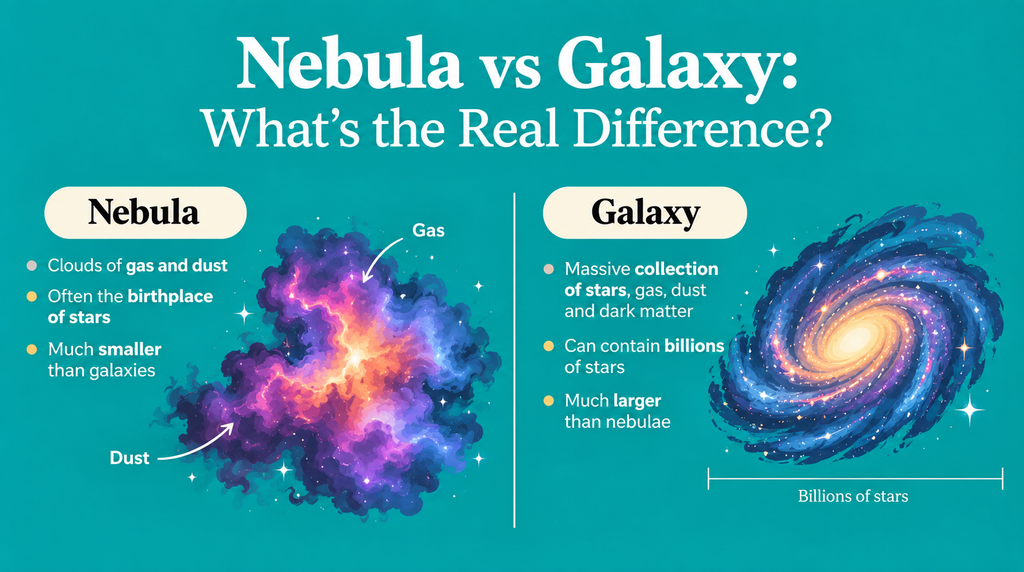
Nebula vs. Galaxy: Quick Snapshot
The fact that a nebulae are usually a few dozen light-years across while a galaxy is usually hundreds of thousands of light-years across can help you create an image in your head. A nebula is a cloud of gas and dust. It can glow, hide, or drift quietly. A galaxy is a huge system that holds those clouds, billions of stars, planets, practically everything in the universe.
Think of a nebula as a workshop and a galaxy as the whole city. The workshop builds stars. The city houses the workshops, the workers, and the rules that keep the place together. Nebulae are local, colorful in pictures, and some are short-lived. Galaxies are vast, structured, and last for billions of years. The Orion Nebula is a good example. It is a cloud of gas and dust inside our Milky Way Galaxy. The Milky Way is the much larger system that contains the Orion Nebula, along with enormous numbers of stars and many other objects.
Comparison table
| Feature | Nebula | Galaxy |
|---|---|---|
| What is it? | A cloud of gas and dust | A huge system of stars, gas, dust and dark matter |
| Size | Usually much smaller | Usually tens of thousands of light years across |
| Contains stars? | May contain stars or regions where stars are forming | Contains many stars |
| Contains gas and dust? | Yes, this is what a nebula is mainly made of | Yes |
| Contains dark matter? | Not what defines a nebula | Yes, dark matter contributes substantially to a galaxy’s mass |
| Where is it found? | Usually within a galaxy | Exists as its own gravitationally bound system |
| Examples | Orion Nebula, Horsehead Nebula | Milky Way, Andromeda Galaxy |
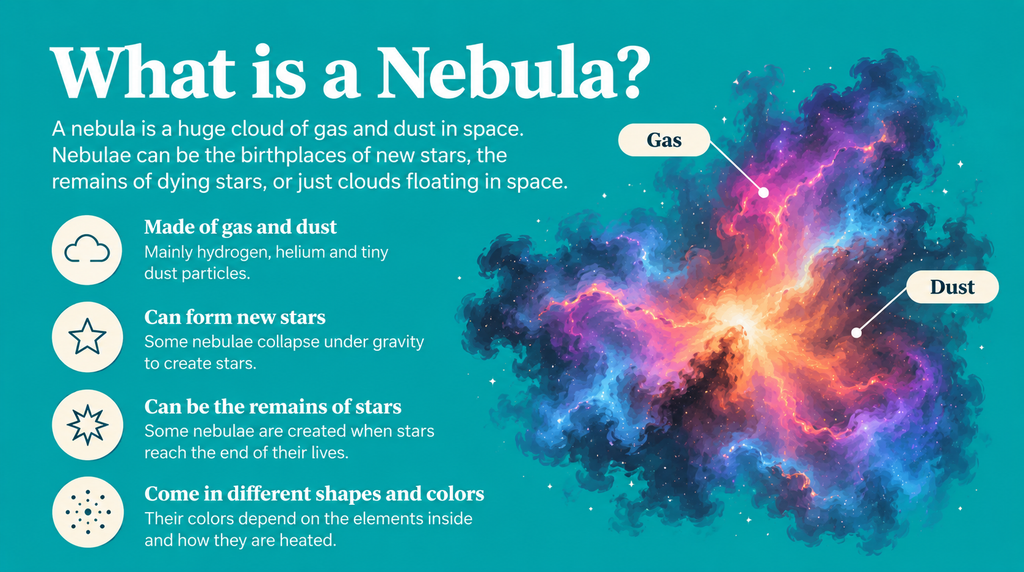
What is a Nebula?
Picture a cloud in the universe, just floating around and looking beautiful. That’s a nebula and sometimes the place where stars are born inside. It’s a vast cloud of gas and dust that can sometimes contain stars and other structures. It has several types, though, and each behaves, looks, and acts differently. Some, like the planetary nebulae, form when dying stars shed their outer layers. The emission nebula glows strongly because nearby hot stars send out strong light that ionizes the gas. Some are thick with dust and appear as dark patches that block the stars behind them.
Not every nebula is a place where stars are being born, though. Some are created from material released by dying stars, while others are clouds that reflect or block light from objects around them. This is why the word “nebula” describes a type of structure rather than one single process.
Despite their dramatic images, nebulae are very thin compared to Earth’s atmosphere. Even the densest parts are an extreme vacuum by our standards. They also contain elements such as carbon, oxygen, and iron that can later become part of new stars, planets, and other objects.
What are nebulae made of?
Nebulae are mostly made of gas and dust. Hydrogen and helium make up most of the gas, while the dust contains tiny solid grains made from heavier elements and compounds. In colder and denser regions, molecules can also form.
When enough gas gathers in a dense region, gravity can pull the material together and eventually contribute to the formation of new stars. In other cases, the material may have been released by a dying star and spread into space.
Types of nebulae
When you are trying to understand a nebula, it’s type matters (it’s the same with galaxies, we’ll come to it) because some glow because nearby stars energize their gas, some reflect light, and some appear dark because their dust blocks light. When you understand these types and even know some popular examples, it makes it easier to identify them.
- Emission nebulae. This is a glowing type. Hot, young stars flood it with energy. Often red in images. Think of these as cosmic neon signs. Ionized hydrogen gas glows under UV radiation from young stars. My first examples, the Orion Nebula is an emission nebula and a great example.
- Reflection nebulae. These are less lighter because the dust scatters light. Usually looks bluish or pale. These act like celestial mirrors. When the dust scatters the light, it creates that blue haze similar to fog reflecting car headlights. M78 in Orion is a well known example.
- Dark nebulae. In this one, the thick dust blocks the light even more, so they look like black lanes or patches. These shadowy giants block light, hiding regions where new stars can form. The Horsehead Nebula is one of these.
- Planetary nebulae. Surprisingly, it has nothing to do with planets. Dying sun-like stars shed shells and leave behind a hot, dense white dwarf at the center. The material that was expelled forms a glowing shell around the remaining stellar core.
Supernova remnants are another important type of nebular structure but they are not really a “type.” So I am adding it here as a footnote. They form from material thrown into space when a massive star explodes. Their expanding gas can remain visible for thousands of years and can tell astronomers about the star that produced the explosion.
What is a Galaxy?
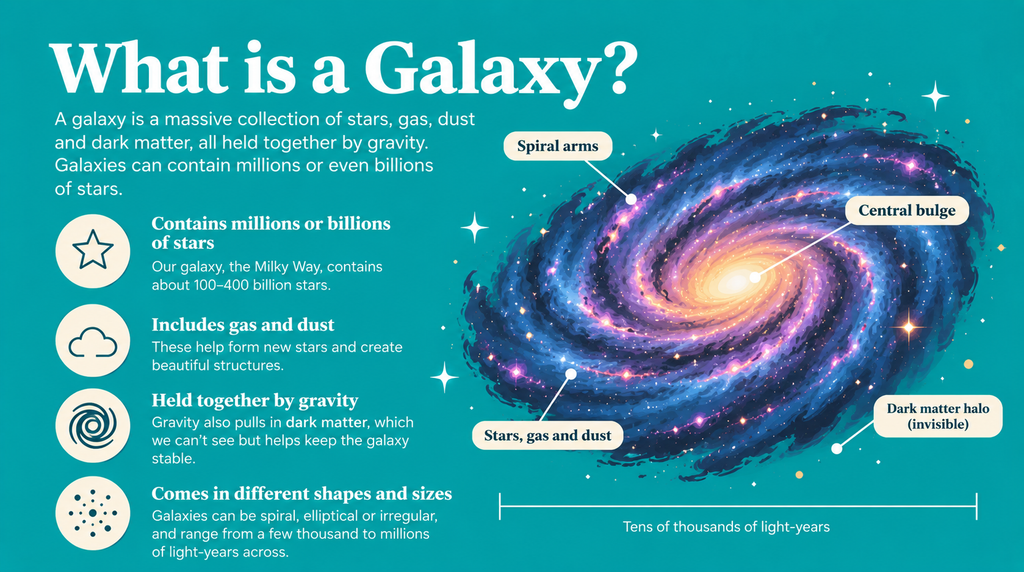
Galaxies are the universe’s metropolises. They are a massive system of stars, gas, dust, and dark matter held together by gravity. Think of billions of stars moving in patterns. Many galaxies have shapes: spirals with arms, rounded ellipticals, or messy irregulars. Inside them are star clusters, black holes, and countless nebulae.
For example, the Milky Way, our home, contains everything: enormous numbers of stars, along with gas, dust, nebulae, star clusters, and even a supermassive black hole at its center. Unlike nebulae, galaxies evolve over eons. They control how gas flows, where stars form, and how chemical elements spread. Galaxies collide and merge with one another. Those interactions can spark new waves of star formation or strip a galaxy of its gas. The core thing that keeps a galaxy together is gravity. Dark matter also plays a major role in the structure and motion of galaxies because it contributes a large amount of unseen mass. As you can see, galaxies are very complex structures compared to nebulae. It is an entire system with it’s own roles and many different astronomical objects.
What is a Galaxy Made Of?
Galaxies are loaded with stars. However, galaxies also host gas and dust between those stars that feed future star formation. Unlike a nebula, the gas is spread thinly across vast distances. Then there’s dark matter. We can’t see it, but its gravity shapes how galaxies form and rotate. Its gravitational effects help explain the motion and structure of galaxies. Galaxies also contain central black holes, star clusters, and streams of gas torn off during interactions. This mix of stars, gas, dust, and dark matter also sets the type of galaxy. There is a quite bit of different types of galaxies, like with nebulae.
Another important thing about galaxies is that gravity keeps a galaxy together. All of the things I mentioned above (stars, gas, dust, dark matter) all contribute to the gravitational structure of a galaxy.
Types of Galaxies
Just like with nebulae, galaxies also have different types. We name them mostly by how they look and we differentiate them by their structure and what’s in it mostly.
- Spiral. This one has a disk with arms and a central bulge. Picture a spiral galaxy as a stellar assembly line. Its arms, rich in gas and cosmic dust, create new stars. The Milky Way is a barred spiral, with a central “bar” across its center.
- Elliptical. These smooth, egg-shaped giants are like retirement communities for stars. They are full of ancient stars and little interstellar gas. They’re quiet but massive. Messier 87 is a good example for an elliptical galaxy.
- Irregular. They are chaotic and rare; they have no set shape. Some can have unusual shapes because of gravitational interactions with other galaxies, although not every irregular galaxy has the same origin.
- Dwarf. As the name suggests, they are smaller galaxies compared to others. Dwarf galaxies are much smaller than galaxies such as the Milky Way and contain far fewer stars. They can have different shapes, but their much smaller size is what sets them apart.
Is a Galaxy Bigger Than a Nebula?
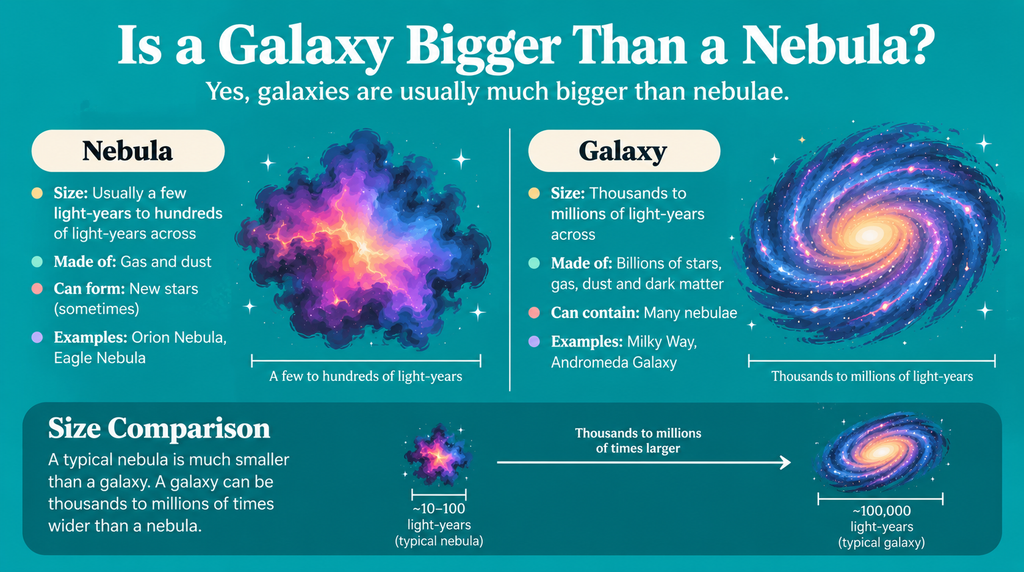
As you may have already understood, nebulae and galaxies are on different scales. This includes their sizes, too. A nebula might stretch a few dozen to a few hundred light-years across. It is big but still local compared to the star cities we call galaxies. A galaxy is way bigger. Tens of thousands to hundreds of thousands of light-years across.
Typical sizes and distances
Nebulae typically range from a few light-years (planetary nebulae) to over a hundred light-years (giant molecular clouds). They usually live inside galaxies, scattered along spiral arms or clustered in star-forming regions. The closest bright nebulae, like Orion, sit just a few hundred to a thousand light-years from us.
The exact size depends on the type of nebula. Some are only a few light-years across, while giant molecular clouds can stretch across hundreds of light-years. Even these enormous clouds are still much smaller than a galaxy.
Galaxies, as you can imagine, can contain many nebulae and other astronomical structures. You can do the math. To put it in numbers, even a small galaxy is thousands of light-years across. The Milky Way is about 100,000 light-years across. The Andromeda Galaxy is even bigger, and it’s still considered just one member of our local group. Most galaxies we see in telescopes are millions of light-years away. Distances here are enormous.
So, a galaxy is a much bigger structure than a nebula. Even a relatively small galaxy can span thousands of light years, while many nebulae are only a few to a few hundred light years across
Can You See Nebulae and Galaxies Without a Telescope?
All the pretty photos you see of nebulae and galaxies are not how they really look. When you use a basic telescope or an advanced one, you won’t be able to see them as they are in the pictures. A fuzzy patch might be a nearby cloud or a distant island of stars. Although, there are some nebulae and galaxies that can actually be seen without a telescope under dark skies, but they usually look very different from the colorful photographs you see online. Long exposures collect far more light than your eyes can, and many astronomical images also combine observations from different wavelengths.
When you look at a nebula or galaxy with naked eye, you can detect some simple things to understand which one it is. Nebulae tend to have ragged edges, wisps, filaments, and bright knots where stars heat gas. They can show dark lanes where dust blocks light. Galaxies are large-scale structures and they are easier to spot depending on their type. Spirals have arms and a central bulge. Ellipticals look smooth.
Essentially, you have to always remember that astronomers don’t guess. They test. They split light into pieces, look at many wavelengths, check how things move, and compare shapes. Those clues show whether you’re seeing a local nebula or a whole galaxy.
Telescopes and Wavelengths
If you do really want to see a nebula or a galaxy, different telescopes act like different senses. You have to buy the right type depending on what you want to see. For example, visible light shows glowing gas, dust lanes, and starlight. Infrared ones cuts through dust and helps show us the stars inside a nebula. Radio maps cold gas and big molecular clouds where stars will form. X-rays and ultraviolet pick up hot gas and shock fronts from explosions.
A nebula often lights up in a few narrow colors. They are specific emission lines from hydrogen or oxygen. That makes it stand out in visible images. A galaxy’s light is a blended glow of millions of stars, so its spectrum looks broad and smooth. Infrared can reveal a dusty galaxy core, or it can show the warm baby stars tucked inside a nebula.
Nebula vs Galaxy: The Orion Nebula and the Milky Way
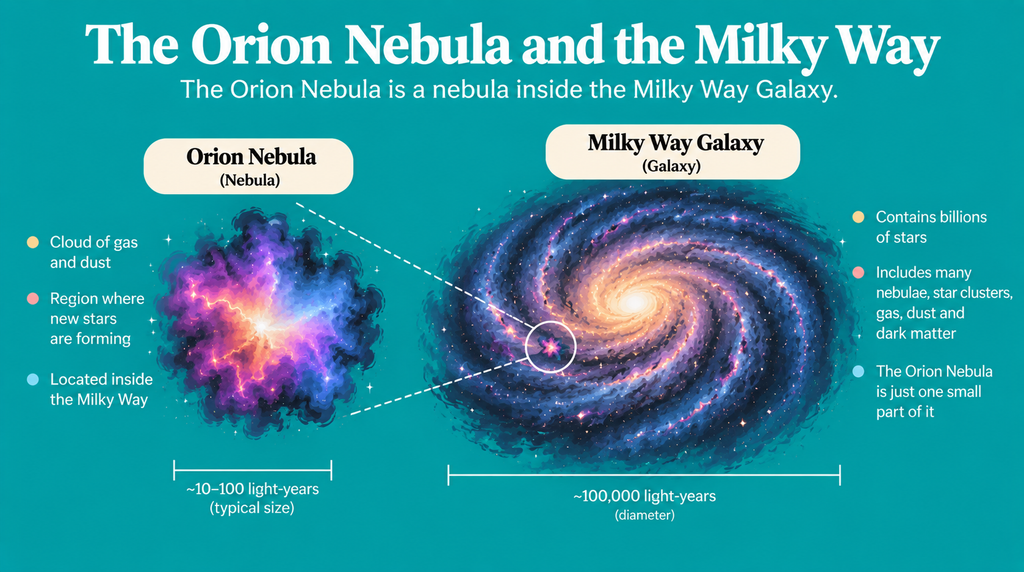
Easiest way to actually know and understand something is to picture it and compare it if possible. In this case, one of the easiest ways to understand the difference between a nebula and a galaxy is to compare two familiar objects to everyone: the Orion Nebula and the Milky Way Galaxy.
The Orion Nebula is a cloud of gas and dust inside the Milky Way. It is part of a region where new stars are forming. The Milky Way, on the other hand, is the entire galaxy that contains the Orion Nebula, along with enormous numbers of other stars, nebulae, gas, dust, and dark matter.
This makes it a bit simpler to remember the relationship. The Orion Nebula is part of the Milky Way, just as many other nebulae are part of our galaxy. A nebula is therefore not competing with a galaxy as another type of galaxy. It is a much smaller structure within one.
FAQ
What’s the main difference between a nebula and a galaxy?
A nebula is a cloud of gas and dust where stars form, while a galaxy is a massive collection of stars, planets, and other cosmic matter bound by gravity. Think of a nebula as a “stellar nursery” inside a galaxy. A slightly more accurate way to put it is that a nebula is a cloud of gas and dust within a galaxy. Not every nebula is a stellar nursery, because some form from material released by dying stars.
Can you see nebulae and galaxies with the naked eye?
Yes! The Orion Nebula and the Andromeda Galaxy are visible under dark skies. Binoculars or a telescope will reveal more detail, like the glowing gas in nebulae or the spiral arms of galaxies.
How do planetary nebulae form?
When a dying star sheds its outer layers, it creates a glowing shell of gas called a planetary nebula. The remaining core becomes a white dwarf, like the Helix Nebula’s central star.
What’s inside dark nebulae?
These dense clouds block light from stars behind them, hiding new star-forming regions. The Horsehead Nebula is a famous example—its dark dust creates striking silhouettes against glowing gas.
How far away are the nearest galaxies?
The Andromeda Galaxy, our closest spiral neighbor, is 2.5 million light-years away. Dwarf galaxies like the Large Magellanic Cloud orbit the Milky Way at about 160,000 light-years.