Each type of star could be very different from one another; some are big, some are small, some die in a burst, and some die quietly and slowly. When those that die slowly and quietly come to the end of their life, they puff their outer layer off and leave a tiny, incredibly dense core. That leftover core is a white dwarf star. It will not keep burning like a normal star, but it will stay hot for a staggeringly long time. This is the short answer to what is a white dwarf star.
But of course, like almost everything in astronomy, it’s not this simple. White dwarf stars are complex stars (basically leftover cores of dead stars) that have a staggeringly long lifetime. That’s why I wanted to write this article to explain how exactly a white dwarf star is born, what happens to it over time, how it compares to neutron stars and other types of stars, and why it’s so important.
Note: Some pictures in this article were generated with the help of Large Language Models (AI).
What is a White Dwarf Star?
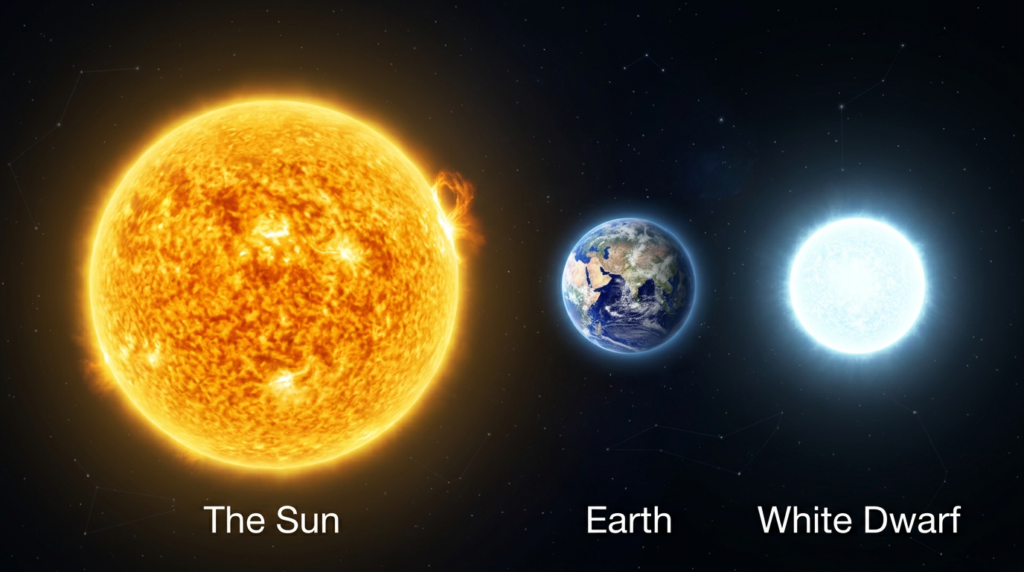
Irrelevant to its type, a star lives its life and dies, like us (well, on paper, the way they live their life and die is nowhere similar to us). However, how they live and what happens after they die depends on their type. For example, a star like our Sun will live its life for several billion years and die (our Sun’s lifespan is estimated to be 10 billion years), and when a star of that type dies, it sheds its outer layers and becomes a white dwarf star. It is no longer making new energy through nuclear fusion. That’s what a white dwarf star is, basically the glowing leftover center of a dead star.
White dwarfs are often about the size of Earth, but they can contain a mass close to the Sun’s. That means matter inside them is packed together in a way that is hard to picture in everyday terms. They are also not rare cases or exceptions in the universe. We expect most stars to end up like this (including our Sun). So, a white dwarf is a common ending a star can have, but it’s still sort of mysterious because of its mass (like neutron stars).
There is also something a little unsettling about them. A white dwarf is what remains after the active life of a star is over. They don’t have regular fusion or a steady star-like life anymore. There is just leftover heat, trapped in a tiny object, slowly leaking away into space.
How Does a White Dwarf Form?
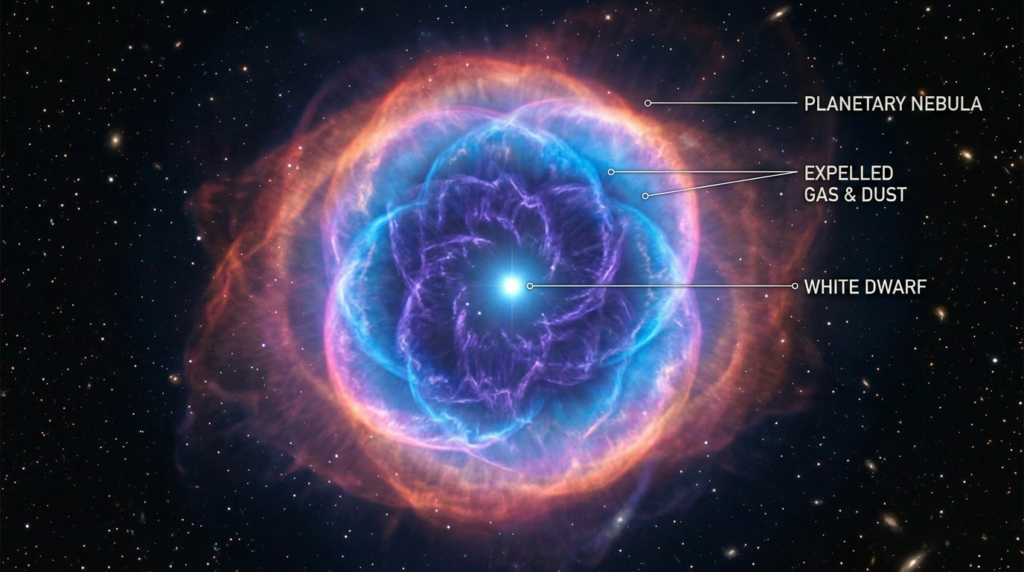
It starts with a star that is not massive enough to become a neutron star or black hole. For most of its life, that star spends its time turning hydrogen into helium in its core. That is the long, stable part of a star’s life, and it is what our Sun is doing right now. Eventually, though, the fuel in the core starts running low. Once that happens, the balance inside the star begins to change. The core contracts, the outer layers expand, and the star swells into a red giant. Later, the star begins losing its outer layers into space. Those layers drift away and can form a beautiful cloud called a planetary nebula. What is left behind in the middle is the exposed core. That core is the white dwarf.
If you want the bigger picture around this, it helps to read how stars form and how stars are classified. White dwarfs only make sense once you realize not all stars live and die in the same way. This is also the future of our own Sun. Not soon, obviously, but eventually. It will not blow up as the biggest stars do. It will go through its red giant stage, shed its outer layers, and end up as a white dwarf.
What is a White Dwarf Made Of?
Most white dwarfs are made mostly of carbon and oxygen. These are the leftovers from earlier stages in the star’s life, after it has already burned through lighter elements. So if someone asks what is inside a white dwarf star, carbon and oxygen are usually the first things to mention. That said, different white dwarfs can have slightly different compositions depending on the original star. Some may contain more helium, and some of the more unusual ones can have different layered structures. But for a normal beginner-friendly explanation, carbon and oxygen are the heart of it.
The Chandrasekhar Limit
White dwarfs cannot just keep growing forever. There is a maximum mass they can have while still staying white dwarfs. That limit is called the Chandrasekhar limit. The number is about 1.4 times the mass of the Sun. If a white dwarf goes above that, it becomes unstable. At that point, the pressure holding it up is no longer enough to keep gravity under control.
This is one of the most important ideas in white dwarf astronomy because it decides whether the star can stay as it is or whether something more dramatic happens next. Cross that line, and the white dwarf can collapse further or explode. If you want to follow the chain of events after that, the natural next read is how neutron stars form.
What Happens to a White Dwarf Over Time?
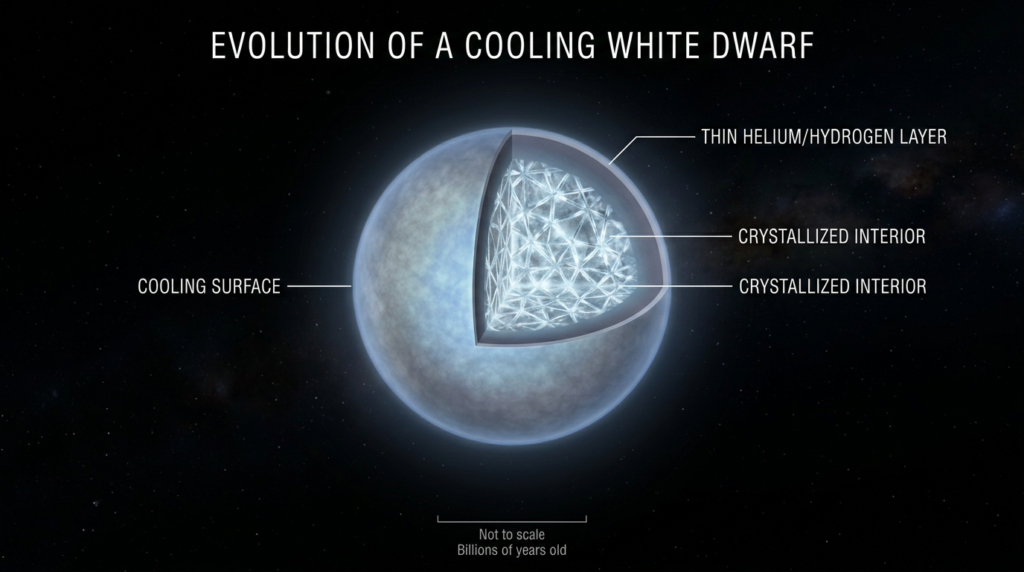
A white dwarf does not stay the way it starts. Once it forms, it begins a very, very long cooling process. Since it no longer has fusion going on, it can only radiate away the heat it already has. The keyword here is slowly. White dwarfs cool over billions and then trillions of years. Their whole later life happens on timescales that are far beyond anything human beings can properly relate to.
And, obviously, the universe is not (yet) old enough for a white dwarf to have fully cooled. Not one. Every white dwarf that has ever formed is still somewhere on that long road downward. That’s why there are still many question marks around what actually happens when they completely cool down. We also don’t know if somewhere along that line, a white dwarf can go above the Chandrasekhar limit. Things can go south if they do, but we are not sure if they actually do. One thing is certain: white dwarfs will outlast almost everything in the universe.
Can a White Dwarf Become a Black Dwarf?
Yes, in theory. If a white dwarf cools for long enough, it should eventually stop glowing and become a black dwarf, a cold, dark leftover that gives off basically no light. But none should exist yet, because the universe is still far too young. White dwarfs need longer than the current age of the universe to cool that much. Black dwarfs, the concept and the name, are just a theory, like many other things I talk about here. Technically, it is possible. In reality? We are not that old.
What Happens if a White Dwarf Has a Companion Star?
You probably know about binary star systems, where two stars orbit each other. The same thing can happen with white dwarfs, too. But things can get a bit different with them. In a normal binary star system, it’s not too violent or too different (it’s not like in multiple star systems, where it’s extremely chaotic).
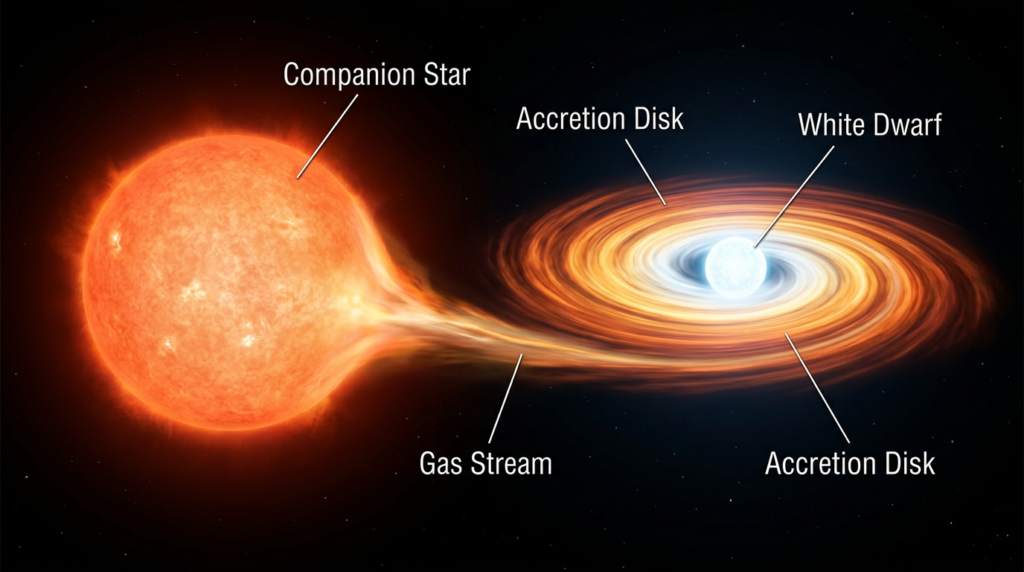
In a binary star system with a white dwarf, one star can pull matter from the other. A white dwarf can steal gas from its companion, and that extra material changes the whole situation. If enough gas piles up on the surface, it can trigger a nova. That is a sudden bright outburst, but the white dwarf survives. If the white dwarf keeps gaining mass and gets pushed too close to the Chandrasekhar limit, the results can be much bigger. In some cases, this leads to a Type Ia supernova, one of the universe’s most powerful explosions.
White Dwarf vs Neutron Star
People mix these up all the time, which makes sense because both are dense leftovers from dead stars. But they are not the same thing. A white dwarf comes from a lower-mass star. A neutron star comes from a more massive one. A white dwarf is about the size of Earth, while a neutron star is far smaller, closer to the size of a city, yet much denser.
Basically, even though white dwarfs are dense, neutron stars are much denser and much smaller with more mass. Neutron stars are the extreme version of white dwarfs, and they are pretty fascinating. Pulsars are also neutron stars, and they are also not something we understand completely. I don’t want to talk about neutron stars too much; this is not the point of this article, and I have detailed articles about neutron stars and what a pulsar is.
The main difference is in its mass (neutron stars have more mass), size (neutron stars are smaller), and density (neutron stars are the densest things we have observed in the universe).
Will Our Sun Become a White Dwarf?
Yes, almost certainly. The Sun is not massive enough to end as a neutron star or black hole. Its future is the white dwarf route. Before that happens, the Sun will expand into a red giant. That stage will completely change the inner solar system. Afterward, it will shed its outer layers, and the core left behind will be a white dwarf.
I think this is one of the reasons white dwarfs are such a good topic for beginners. They are not just some distant abstract object. They are part of our own Sun’s future story. However, don’t be alarmed because our Sun is only 4.6 billion years old, and we estimate its lifespan to be 10 billion years. We’ve got some time until the Sun reaches a point to start turning into a white dwarf.
Conclusion
In the end, a white dwarf star is what a lot of stars become when their main life is over. It is the hot, dense core left behind after a smaller star runs out of fuel and sheds its outer layers. They are Earth-sized, dense, and a bit lighter in mass. White dwarfs are the common beings of the universe, but we never see one disappear because the universe is not that old yet. They will outlast almost everything else in the universe. Even though they are common, they are still very interesting, and we may learn more about them as time goes on.
FAQ
What is a white dwarf star in simple terms?
A white dwarf star is the hot, dense leftover core of a smaller star that has run out of fuel and shed its outer layers.
Will our Sun become a white dwarf?
Yes. The Sun is expected to end as a white dwarf after it goes through its red giant phase and loses its outer layers.
How long does a white dwarf last?
A white dwarf can keep cooling for trillions of years, which is much longer than the universe has existed so far.
What is the Chandrasekhar limit?
It is the maximum mass a white dwarf can have and still remain stable, roughly 1.4 times the mass of the Sun.
What is the difference between a white dwarf and a neutron star?
A white dwarf comes from a lower-mass star and is larger but less dense, while a neutron star comes from a more massive star and is much smaller and denser.