In 1967, Jocelyn Bell Burnell, a PhD student, was going through reams of radio telescope data when she spotted a repeating signal. It was repeating every 1.33 seconds with almost mechanical precision and was too consistent and regular that her team jokingly named it LGM- 1 (Little Green Men). It was probably one of the first real moments where we thought we encountered alien communication, but it wasn’t. This was a pulsar, a dead star about the size of a city, sweeping a beam of radiation across the universe with the precision of an atomic clock. But what is a pulsar? Where do they come from? What is all that precision about? Do we know more about it than other unusual things in space, like dark matter or black holes?
If interesting, I talked about dark matter in a few different articles, why they are unusual, and how we don’t know anything about it.
Note: Some images in this blog post was created with the help of AI.
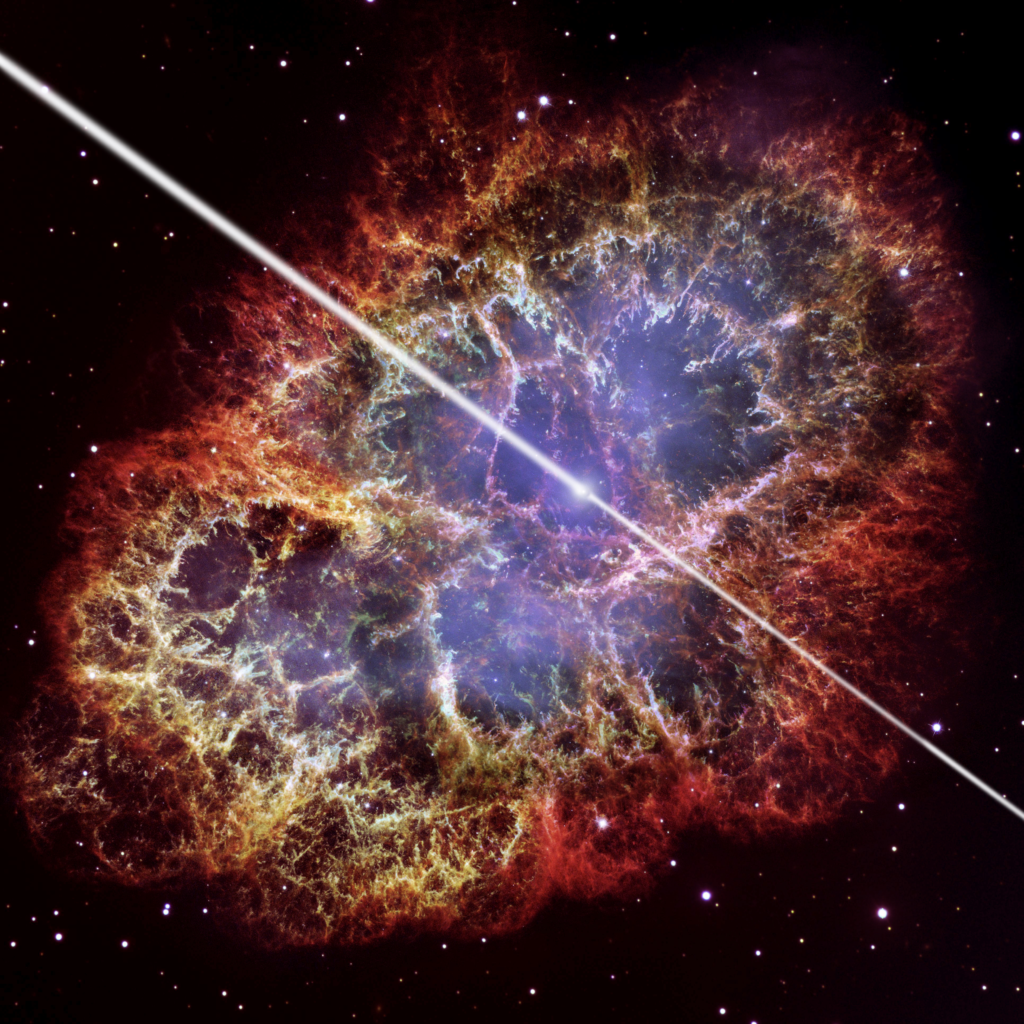
What is a Pulsar?
A pulsar is a rapidly spinning neutron star that shoots beams of electromagnetic radiation from its magnetic poles. As it rotates, those beams sweep across space like the light from a lighthouse. If one of those beams happens to sweep past Earth, we detect a pulse. That’s it. That’s a pulsar. The name is short for “pulsating radio star,” which tells you exactly what it looks like from our perspective. A star that pulses but is not switching on and off.
To understand what a pulsar is, you first need to understand what a neutron star is because all pulsars are neutron stars in essence (but not all neutron stars are pulsars). I’ve covered how neutron stars form in detail before, so I won’t go too deep here. The short version is that when a massive star dies in a supernova explosion, the core that’s left behind collapses under gravity. If that core is heavy enough, but not quite heavy enough to become a black hole, it becomes a neutron star. A ball of matter so dense that a teaspoon of it would weigh a billion tons.
How Does a Pulsar Form?
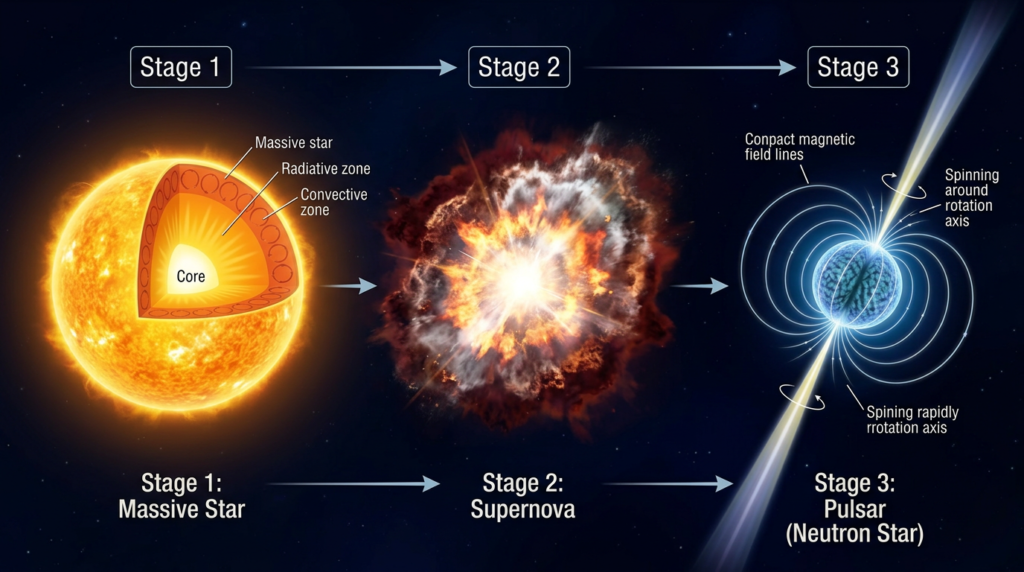
It starts with a massive star, at least eight times heavier than our Sun, burning through its nuclear fuel for millions of years. Gravity is always trying to crush it inward. The energy from nuclear fusion pushes outward. It’s a constant standoff. When the fuel runs out, gravity wins. This is actually a pretty common story among many stars (that’s how black holes are also formed), so it shouldn’t be a new story if you read my other articles. Once the gravity takes over, the star’s outer layers explode in a supernova. It’s one of the most violent events in the universe. Meanwhile, the core collapses inward in less than a second. A star that was once a million kilometers wide becomes a dense ball about 20 kilometers across.
As part of the story of stellar life and death, as the core collapses, it spins faster. Imagine it like a spinning ice skater pulling in their arms. The original star might have rotated once a month before it died. The new one, the neutron star, that’s left spins dozens or even hundreds of times per second. On top of that, the collapse also amplifies the star’s magnetic field to an insane degree, billions of times stronger than Earth’s. That magnetic field and the fast rotation combine to produce the beams of radiation shooting from the poles. That’s how you get a pulsar.
Why Does a Pulsar Pulse?
This is the part that many people are curious about, and many people can get it wrong. The pulsar is not switching on and off. It’s always beaming radiation from its magnetic poles. Always. The pulse we detect on Earth is the beam sweeping past us, not turning on. Think of a lighthouse. The light inside is always on. But you, standing on the coastline, see it flash once per rotation. Between flashes, the beam is pointing somewhere else.
A pulsar works exactly like that. The neutron star’s magnetic axis isn’t perfectly aligned with its rotation axis, similar to how Earth’s geographic north pole and magnetic north pole aren’t the same point. So as the pulsar spins, the beams trace a cone through space. If Earth is sitting in that cone’s path, we get a pulse every time it sweeps past.
The interesting part is actually not the pulses but how precise they are. Like a lighthouse, for example, moves the same way, but the light may turn slower at times or may point at different parts (even with a millimeter difference), but a pulsar’s pulse isn’t. There are pulsars we’ve been timing for decades, and we can predict their next pulse to within microseconds. That kind of precision is almost impossible to find anywhere else in nature. That’s why in 1967, we thought it might be alien communication.
The Types of Pulsars
With all that said, there is not one single type of pulsar, and they are all different. They come in a few flavors, and the differences are worth knowing (if you are interested, if not, just skip to the next section). They are not so different from each other like black holes are, but it’s interesting to know.
Radio Pulsars: The Classic
This is the “original” pulsar that Jocelyn Bell Burnell discovered in 1967. We call them radio pulsars (the majority of the known pulsars are radio pulsars), and they emit their beams at radio wavelengths. They’re the best studied, the most common, and the ones most people mean when they say “pulsar.”
Millisecond Pulsars: The Speed Demons
These pulsars spin about 50 times per second, some spinning as fast as 716 times per second. They are the fastest known pulsar type (PSR J1748-2446ad), and they are also the most stable. Their spin rates decay slowly over time, which makes them very useful to act as clocks (more on it later). But, how do they get so fast? A companion star spins them up. In a binary star system, the pulsar can pull material off its companion. That infalling matter transfers angular momentum, essentially giving the pulsar a long, sustained push like spinning a top by continuously flicking it.
X-ray Pulsars
These are usually found in binary systems where the neutron star is actively pulling matter from a companion. The infalling material heats up to extreme temperatures and emits X-rays. The rotation of the neutron star then modulates that emission into pulses. These were discovered in the early 1970s and gave us a completely new window into how neutron stars behave when they’re feeding.
Gamma-ray Pulsars
These are young neutron stars with extremely powerful magnetic fields that emit beams at the highest end of the electromagnetic spectrum. They are high-energy sources and are relatively rare. The Fermi Gamma-ray Space Telescope has found hundreds of them, and many of them were invisible at radio wavelengths. It’s a great example that many things in the universe, including pulsars, may beam or exist in wavelengths or locations we are not looking at.
Magnetars
Magnetars aren’t technically a subtype of pulsar, but they’re close enough. They’re neutron stars with magnetic fields roughly 1,000 times stronger than a typical pulsar. Most of the time, they’re quiet. But occasionally they release enormous bursts of energy that can be detected from across the galaxy. If you’ve ever read about how extreme neutron stars get, magnetars are the extreme edge of that extreme.
The Discovery of the Pulsar
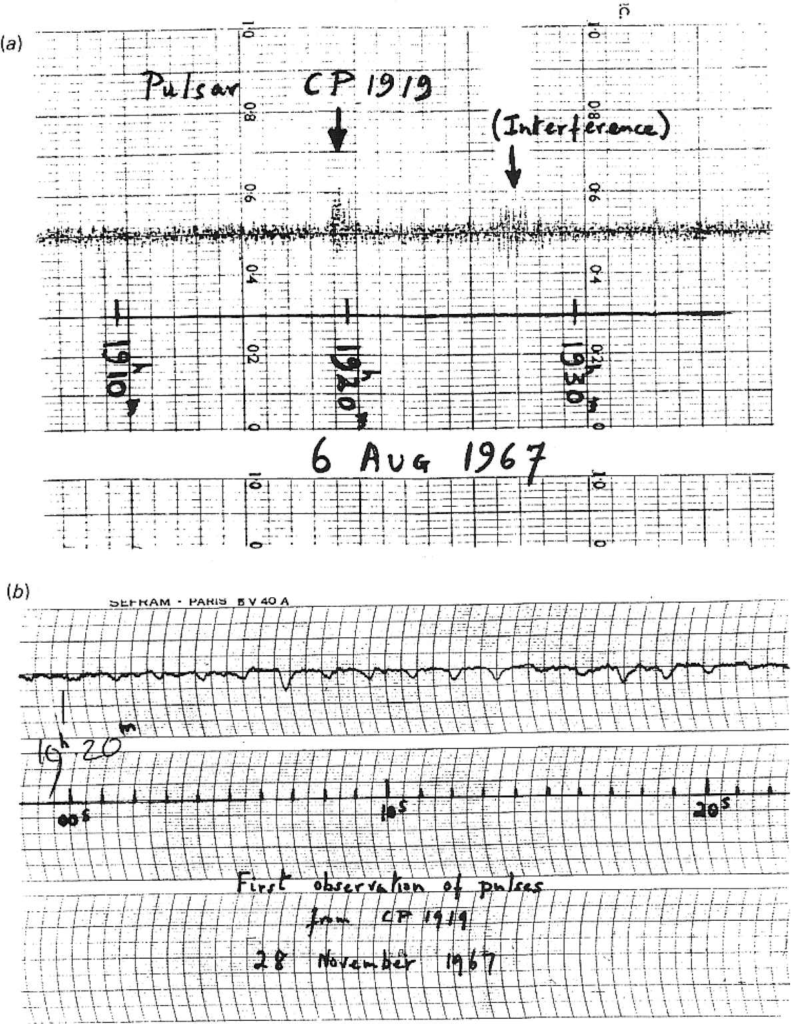
I want to go back to 1967 and explain the discovery of the pulsar in more detail. The reason I think it is important is that the universe has many things we can’t even remotely understand, and it’s hard to distinguish between what its structure is and what it isn’t. Jocelyn Bell Burnell was a 24-year-old PhD student at Cambridge. She’d helped build a radio telescope and was going through the data printouts by hand, literally squinting at long rolls of paper looking for anomalies. She found one and described the signal as “a bit of scruff”, a repeating pattern that didn’t look like interference or a known source.
Her supervisor, Antony Hewish, initially thought it was man-made interference. Then they realized the signal was moving with the stars, which meant it was definitely coming from space. When they clocked the timing more precisely and found it was repeating every 1.33 seconds with near-perfect regularity, the team started ruling out natural causes one by one until the only thing left on the list was something artificial.
It is now named PSR B1919+21. Within months, they found a second one. Then a third. Naturally, everyone understood that this is something that happens in the universe, in nature, not artificial or a transmission. Which was still a huge discovery on its own because we discovered something that we didn’t know existed, according to our understanding of the universe’s rules.
A fun fact: Hewish won the Nobel Prize in Physics in 1974 for this discovery, and Jocelyn Bell Burnell, who actually found it, did not.
What Are Pulsars Actually Used For?
This is the part that surprised me most when I first got into this topic and started researching it. Pulsars aren’t just things we discovered and part of an unused side of physics. They’re genuinely useful tools, some of the most useful objects in the universe for doing physics. They can act like clocks, proving and testing theories (like general relativity), navigation for spacecraft, and many more. This happens because of their unique physicality and how they work. Since this is something that we didn’t know could exist, we can use them for different purposes, like their insane stability.
Cosmic Clocks
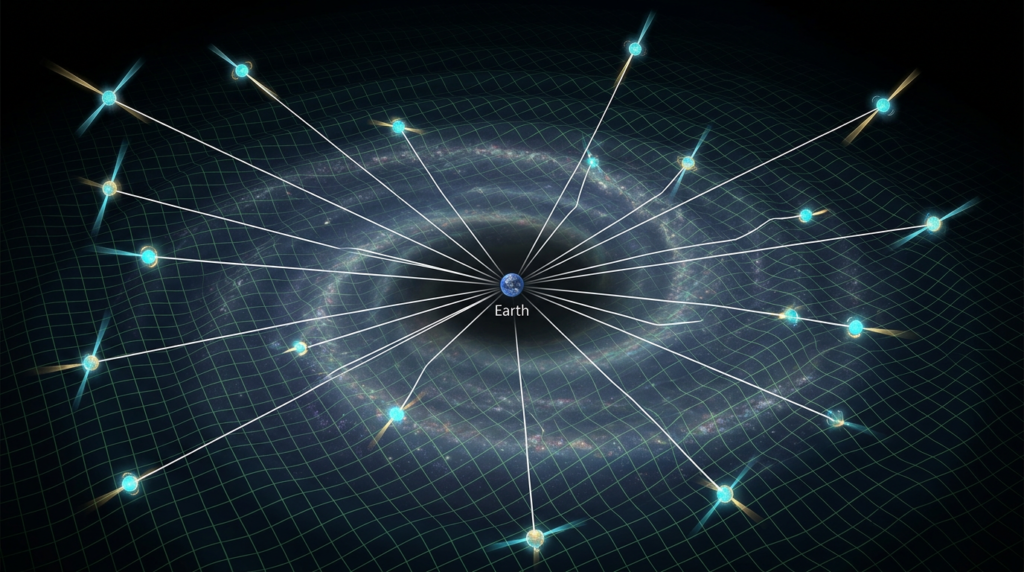
Millisecond pulsars are so stable that astronomers use their networks, called Pulsar Timing Arrays, to detect ultra-low-frequency gravitational waves passing through the galaxy. The idea is that if a gravitational wave ripples through space, it will subtly alter the arrival times of pulses from multiple pulsars in a correlated way. You’re essentially using dead stars as a galaxy-sized gravitational wave detector. This is the ‘clock’ I mentioned. We can’t detect certain things in the universe, like extremely low frequency waves; we just don’t have the technology. But we can use an intermediary.
Testing General Relativity
Another way we can use pulsars is to test out some theories and find evidence of what we think exists out there. One of those is general relativity and gravitational waves. In 1974, astronomers Russell Hulse and Joseph Taylor discovered a pulsar in a binary system (two neutron stars orbiting each other). By tracking the pulsar’s timing over years, they found that the orbit was slowly shrinking at exactly the rate Einstein’s general relativity predicted for energy lost to gravitational waves. This was the first indirect evidence for gravitational waves, which was decades before LIGO detected them directly. Hulse and Taylor won the Nobel Prize in 1993 for it.
Spacecraft Navigation
You can also use pulsars as some sort of a GPS for deep space, using pulsar timing. There are many aspects to it, but essentially it uses the pulsar’s vibrations and their locations as reference points to triangulate Earth’s location in the galaxy. To turn this theory into reality, NASA has been testing a pulsar-based navigation system called NICER/SEXTANT. The Voyager Golden Record, sent into interstellar space in 1977, even includes a pulsar map as a kind of cosmic address. It uses 14 pulsars as reference points.
The First Exoplanet
This one is flying a little under the radar, not a lot of people know it, but the first exoplanet (a planet outside of our solar system) we found was orbiting a pulsar. It wasn’t orbiting a star like our Sun or something we can be confident about. In 1992, astronomers detected tiny variations in a pulsar’s timing that could only be explained by the gravitational tug of orbiting planets. It was a genuinely strange discovery, planets surviving the supernova explosion that created the pulsar, or forming from the debris afterward. Either way, it changed our understanding of where planets can exist. Everywhere, apparently. Since then, it opened up a whole new discovery for us because now we could look outside our solar system for planets that may host life. I believe this is the biggest thing a pulsar helped us find.
Pulsar vs Neutron Star: What’s the Difference?
I mentioned this at the start, and it’s worth spelling out clearly. All pulsars are neutron stars. Not all neutron stars are pulsars. A neutron star only appears as a pulsar if its beam sweeps past Earth. There could be thousands of pulsars pointing their beams in directions we’ll never be in the path of. We’ll never know if they exist. They’re out there sweeping radiation across the universe, and we just don’t happen to be on their rotation plane.
Think of that lighthouse. The lighthouse exists whether or not you’re standing on the coastline to see it. If you’re inland, you’ll never see it flash. It’s still there. The same logic applies to neutron stars. The ones we call pulsars are simply the ones whose beams happen to sweep past us. We’re seeing a fraction of what’s actually out there.
Pulsars also slow down over time. As they radiate energy, their spin rate decreases, slowly, but measurably. Eventually, after tens to hundreds of millions of years, a pulsar spins down so much that the beam weakens and effectively disappears. The neutron star is still there, but we can’t detect it as a pulsar.
Why Pulsars Are Important
In the end, what is a pulsar? It’s a neutron star. Pretty clear and easy. A dead star the size of a city, spinning up to hundreds of times per second, shooting beams of radiation into the universe with an extreme precision that we can’t match artificially. That’s what makes pulsars different and interesting from most other things in the universe.
When Jocelyn Bell Burnell first saw that repeating signal, the most exotic explanation her team could come up with was alien life, which tells us how different a thing it is. A star that died, collapsed, and was reborn as something almost impossibly dense and fast and precise.
We’ve used pulsars to test Einstein, to hunt for gravitational waves, to navigate spacecraft, and to find the first exoplanets. And we’ve only known about them since 1967. I genuinely wonder what we’ll use them for next. If you want to go deeper on the stellar death sequence that creates them, my article on how neutron stars form is worth reading alongside this one. And if the density of these things is still unclear or you want to learn more, check out the piece on how hot and extreme neutron stars really get. If you want to understand pulsars, you can read about neutron stars in general.
FAQ
What is a pulsar in simple terms?
A pulsar is a rapidly spinning neutron star that emits beams of radiation from its magnetic poles. As a pulsar rotates, beams sweep through space. If one of them sweeps past Earth, we detect a regular pulse of radio waves or other radiation.
What is the difference between a pulsar and a neutron star?
All pulsars are neutron stars, but not all neutron stars are pulsars. A neutron star becomes a pulsar only when its rotating beam of radiation sweeps past Earth. If the beam never points our way, we’d never know the pulsar exists, but the neutron star is still there.
Why do pulsars pulse?
Pulsars don’t actually switch on and off. They pulse because they’re spinning. The beam of radiation shoots continuously from the magnetic poles, but it sweeps across space as the star rotates. Each time it points toward Earth, we detect a burst.
How fast do pulsars spin?
It varies. Ordinary pulsars spin a few times per second. Millisecond pulsars, which have been spun up by accreting matter from a companion star, can spin hundreds of times per second. The fastest known pulsar, PSR J1748-2446ad, completes 716 full rotations every single second.
What was the first pulsar discovered?
The first pulsar was discovered in 1967 by Jocelyn Bell Burnell, a PhD student at Cambridge. As I said, it looked artificial, not natural, so they thought it was an alien message, and they temporarily named it LGM-1 (Little Green Men). It was later renamed PSR B1919+21 and recognized as a rotating neutron star. Antony Hewish, Bell Burnell’s supervisor, received the 1974 Nobel Prize for the discovery.