There are a lot of mysterious things in the universe. Some of those things, we can try to understand because we can see the entire thing. But some things, like black holes, are mostly a mystery. We can’t even see the thing; we barely generated an image of one only recently. As you can imagine, there is no way for us to know what a black hole leads to. There are many theories, one of them is could black holes lead to parallel universes. When you pass the event horizon and go to the bottom – which we call the singularity – could it open a door to another universe?
Check this article out, too: Where is the Andromeda Galaxy?
Nikodem Poplawski suggested this theory, and it kind of stuck in the “why not” part of science. Nikodem’s work essentially suggests that our universe exists inside a black hole and that itself is part of a much larger parent universe. You can understand what this means. He just didn’t say it for speculation; he has mathematical models that create a legitimate framework. But like many things in astronomy and astrophysics, it’s only a mathematical framework. How real is it, though? Could black holes lead to parallel universes for real?
Brief Introduction to Black Holes and Black Hole Theories
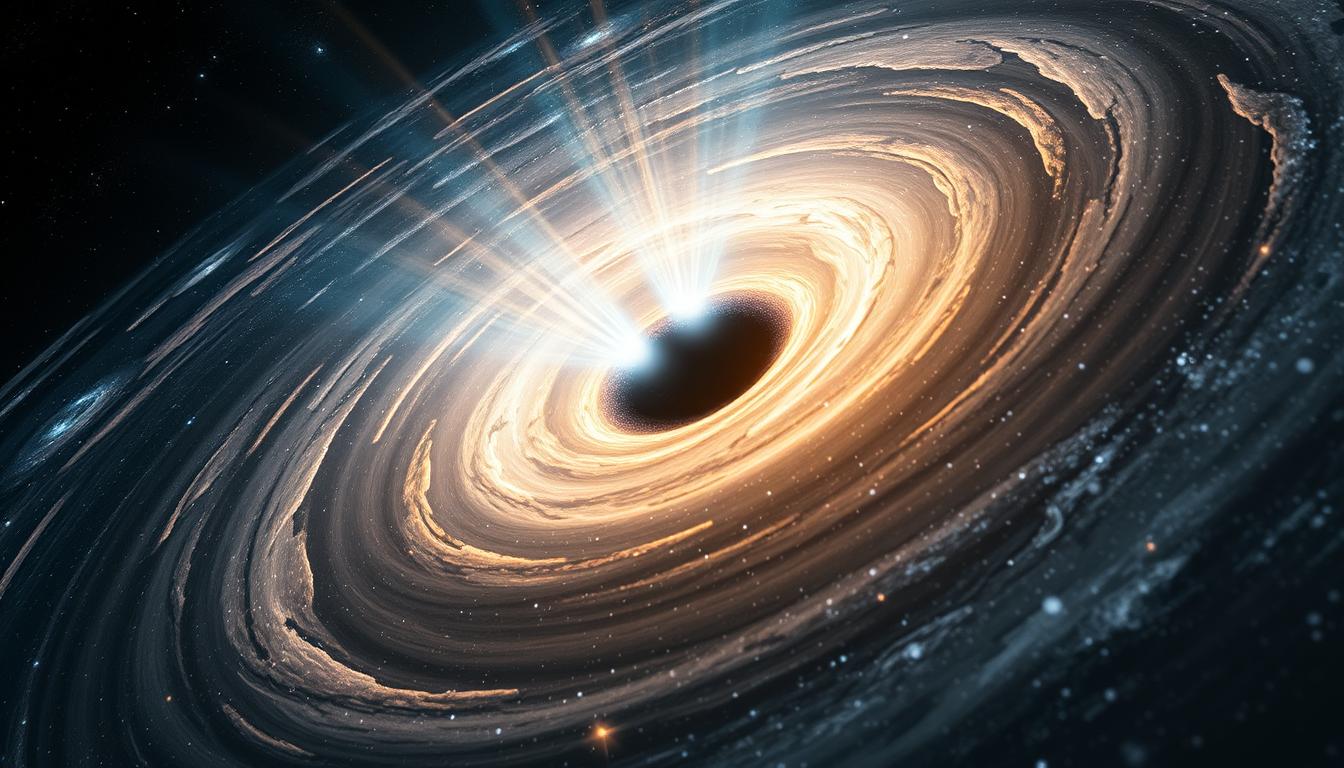
Black holes are mostly mysterious to us, and they never fail to spark our imagination the more we research them. They are essentially regions in space where gravity becomes so strong that nothing, not even light, can escape its power. That’s why they are “black” holes. We can’t see it because there is not even light. Over the years, astronomers have developed several theories to explain how black holes form and what might happen within them.
The most realistic scenario we know about how black holes form is that they happen at the end of a giant star’s life. It collapses inward catastrophically, which creates these holes. Now, what happens inside it after it forms? Well, that’s more of a mystery than how it forms. One way or another, we can observe how a black hole forms, but we can’t see what happens inside. Could black holes lead to parallel universes, or is there a singularity, and is it just nothing inside?
Formation of Black Holes
Black holes mainly form when massive stars run out of fuel. Basically, when a star can no longer produce the power to fight gravity, it collapses under its own weight. For most of the biggest stars, this collapse crushes the material to a single point. That “point” is what starts a black hole, a bottomless hole where gravity is winning over everything. There are different types of black holes depending on the type of star that dies out. Some black holes become supermassive blackholes and some become smaller. They can also form when dense objects merge (like neutron stars), but the core idea is the game: gravity takes over.
Singularity Concept
Coming back to our main question, what happens in the middle, inside a black hole, after it forms? The most widely accepted and realistic framework comes from general relativity. According to classical general relativity, everything is compressed into a point of infinite density. This point is called a “singularity.” Basically, with all that gravity pushing everything, all matter gets crushed at the center of a black hole. It’s infinite density and temperature. What’s that? We also don’t know it well.
Our understanding of physics, energy, and matter breaks down from this point onwards. This is the edge of our understanding of everything. The word “singularity” is simply a way of acknowledging that our current mathematical models break down.
The equations of general relativity predict infinite density and zero volume, but infinities aren’t something physicists like dealing with. It’s a sign we need a better theory, one that we can describe. That’s where the idea of whether could black holes lead to parallel universes come in.
Nikodem Poplawski’s Theory: Could Black Holes Lead to Parallel Universes?
Nikodem Poplawski opened another way for us to think about what is in the middle of black holes. He is a theoretical physicist and, essentially, instead of thinking of singularities as dead ends, his theory suggests that black holes may be gateways. Using a twist on Einstein’s equations (literally, it’s called “torsion“), Poplawski proposes that matter doesn’t collapse infinitely but instead rebounds, creating what could be a brand-new universe on the other side. Going with this thinking, our universe might be one of the “baby or bubble universes” born inside a black hole from a parent universe.
Torsion in Spacetime: Avoiding Singularities
Poplawski’s big idea is about torsion. That’s the “twist” in spacetime when you account for the spin of particles, not just their mass. In standard general relativity, it bends spacetime. When you add torsion, it adds another kind of geometric move: twisting. At extreme densities like in a black hole’s singularity, the “twist” becomes anti-gravity. A black hole is about gravity, so when you put a strong anti-gravity in there, it stops the matter from reaching singularity. Now, you have something that’s a bit spread out inside a black hole. As a result, Poplawski thinks that there is a “white hole” that pushes material into a new reality. Whatever black holes emit from the universe it opened in, it pushes those things to a new reality to create a new universe.
How Torsion Acts as a Repulsive Force
Think about it like this: gravity is always trying to squeeze something, but torsion pushes back when densities get extreme. Imagine spacetime as a super stretchy fabric; gravity stretches it, but torsion gives it just a bit more “give” under enormous pressure. This repulsion isn’t noticeable in everyday life, but inside a black hole, it means matter rebounds—like a cosmic trampoline.
The Einstein-Cartan Extension of General Relativity
The idea of torsion was first explored and introduced in the Einstein-Cartan Extension of General Relativity. It basically proposes what I described above (spacetime connection has a “twist” or “torsion”). Poplawski’s model relies on this extension. While Einstein’s general relativity describes how mass curves spacetime and creates gravity, it doesn’t factor in the “spin” of particles. With the introduction of torsion, it becomes a crucial feature at extremely high densities.
So what exactly sets Einstein-Cartan apart? Standard general relativity assumes that spacetime is curved but smooth. Einstein-Cartan, however, adds “spin” as a source of torsion, acknowledging that fundamental particles all have intrinsic angular momentum. This means spacetime isn’t just curved; it can also be twisted. At low densities, this twist is basically undetectable, but at black hole-level extremes, it changes everything.
The Role of Spin and Torsion
As you may guess, the spin and twist that the torsion creates is the magic here from a formula perspective. Every particle (like electrons or protons) spins, and in the Einstein-Cartan theory, their collective spins cause spacetime to twist and bend. Think of it like a fabric that’s being wrung out as it’s stretched; gravity pulls and bends it, but the underlying spin is twisting it, too. This twisting (torsion) is usually negligible in everyday conditions, but when matter becomes incredibly dense, such as inside black holes or during the early moments of the universe, torsion becomes significant. It provides a new kind of resistance, counteracting the intense gravitational pull and preventing matter from collapsing.
How Torsion Alters Gravity at High Density
When this resistance counteracts gravity and prevents the matter from collapsing, we stop the singularity. It doesn’t happen because there is something going against the usual rules we know. Imagine a very strong man holding a piece of wood and pushing a few skinny men. He easily pressures them and can crush them. Torsion is like if you put a similar-sized strong man on the other hand, it pushes the original man back. He bounces and moves around. Between two strong men, there could be emptiness as they push each other around, and you can pass through it. That’s what torsion does to gravity at extremely high densities (in black holes).
Baby Universes and Wormholes
So, matter rebounds at a black hole’s core, leaving enough room open for something to be able to pass through. What’s that, what happens with that, with enough room open? Poplawski’s ideas suggest these bounces and openings might launch into “baby universes,” each with its own expanding spacetime. Some refer to it as the bubble universe theory, while others use a different term. The idea is the same – there is another universe at the end of a black hole. These newborn universes could be totally separate from our own, hidden behind the event horizon and forever out of reach from our perspective.
The Big Bounce Mechanism
Picture it like this: matter falls into a black hole, gets massively compressed, but instead of stopping at a singularity, it bounces back and inflates. Not into our universe, but into a newly created one. This is the “Big Bounce”, a replacement for the traditional Big Bang singularity. The new universe on the “inside” would be expanding, full of energy and potential, while to us on the “outside,” the black hole remains a one-way portal.
Einstein-Rosen Bridges and White Holes
If you haven’t thought about it yet, the idea of baby universes and the big bounce mechanism correlates well with the idea of wormholes. The Einstein-Rosen Bridge, remember? If you are not familiar with the concept, check out my articles on wormholes. Essentially, it’s the idea that there are tunnels in the universe where each end of a tunnel connects to different universes.
Poplawski’s mathematical models on whether black holes could lead to parallel universes propose that Einstein-Rosen bridges, also known as wormholes, exist inside black holes. When matter goes past the event horizon, it doesn’t collapse into a singularity. Instead, it travels through a gateway to another universe.
Testing the Theory: Observational and Theoretical Challenges
Okay, all this is fancy, exciting, and nice. But can we ever know if black holes really lead to parallel universes? Is there any chance we can detect this and have proof of it? Well, no. There are extremely serious problems in achieving this. Creating observational proof is impossible right now, with our technology. All of these ideas are only on blackboards, computer simulations, and mathematical formulations right now. The primary goal is to find that observational evidence. It’s hard because past the event horizon, nothing can escape the pull of a black hole. How are you going to get that observational evidence?
What Could Point to a Black Hole Universe?
If we can’t see it, are there any other possible ways to determine and have proof of this? There could be. Some options are:
- Indirect clues in the cosmic microwave background, especially patterns that don’t fit standard models, might hint at universe-within–a–blackhole scenarios
- Properties of supermassive black holes and their growth over time
- Signals from gravitational waves or high-energy events are different from what classical relativity predicts
But so far, there’s no “smoking gun”—the nature of event horizons makes it very challenging for us to know what’s really happening inside.
Problems with Exotic Matter and Wormhole Stability
Since wormholes and the idea of black holes opening to parallel universes are now in line, the problems also align. In our mathematical formulas, if traversable wormholes really exist (and to keep such a wormhole open, including the hypothetical one in a black hole), we need matter that we don’t have or can’t detect right now. Exotic matter. This is one of the major theoretical roadblocks. Exotic matter is a hypothetical substance with negative energy density; without some form of it, wormholes snap shut. Right now, we don’t know if exotic matter exists in nature, or if there’s something unknown yet at work in black hole dynamics.
Evidence from Gamma Ray Bursts and Cosmic Inflation
Scientists are also looking at gamma ray bursts—cataclysmic explosions in distant galaxies—and cosmic inflation for hints. If our universe did, in fact, emerge from a black hole “big bounce,” there might be subtle imprints left in these phenomena. Gamma ray bursts are the universe’s second-most powerful events after the Big Bang. Poplawski suggests these explosions might be matter escaping from other realms. Supermassive black holes could serve as cosmic gateways.
The theory also explains why our universe appears remarkably flat. After 13.7 billion years, space should show curvature. Distant regions share the same temperature despite never exchanging light or heat. This horizon problem finds resolution through wormhole connections.
Conclusion
When I started writing this article, I spent a bit of time on whether it makes sense to write this or not. Mostly because the answer is simple: possibly. There is no yes or no answer, but then I realized that’s what makes this question interesting: could black holes lead to parallel universes? Why is there no definite answer? Well, because we think that our mathematics and physics may allow for such a thing, but we have never seen it ourselves. And we can’t see it. Nikodem Poplawski really helped us get started with the possibility that black holes could be more than singularities at the end of them.
All this, of course, leads to many more questions. Does our universe exist in a black hole as a parent universe? Is our universe part of billions of the same or similar universes, or is ours the center and there are satellite universes? We don’t know, and that’s not our main quest. Our main quest is whether the end of the black hole is a singularity or a travel portal, a wormhole. Theories say it’s possible. Reality is still blurry.
FAQ
What is a black hole?
A black hole is an area in space where gravity is so incredibly strong that nothing, not even light, can escape its pull. They form when massive stars collapse under their own gravity at the end of their life cycles.
What is the theory linking black holes to parallel universes?
Some theoretical models, like those involving wormholes, suggest that the extreme physics inside a black hole might not end in a singularity. Instead, it could form a bridge—a tunnel—to another point in spacetime, possibly a different universe or a white hole.
What is a wormhole?
A wormhole is a hypothetical tunnel in spacetime, often visualized as a shortcut connecting two distant points or even different universes. In theory, a black hole could be one end of such a tunnel, but traversing it remains a concept from theoretical physics, not proven reality.
Is there any scientific evidence for black holes’ connection to parallel universes?
Currently, there is no direct observational evidence. The ideas come from studying mathematical solutions in general relativity and exploring concepts like cosmic inflation.