If you have ever looked up what astronomy and astrophysics mean and wanted to compare astronomy vs astrophysics, you may have noticed that the two terms seem almost the same. Both deal with stars, planets, galaxies, black holes, and the universe. But what actually separates astronomy from astrophysics?
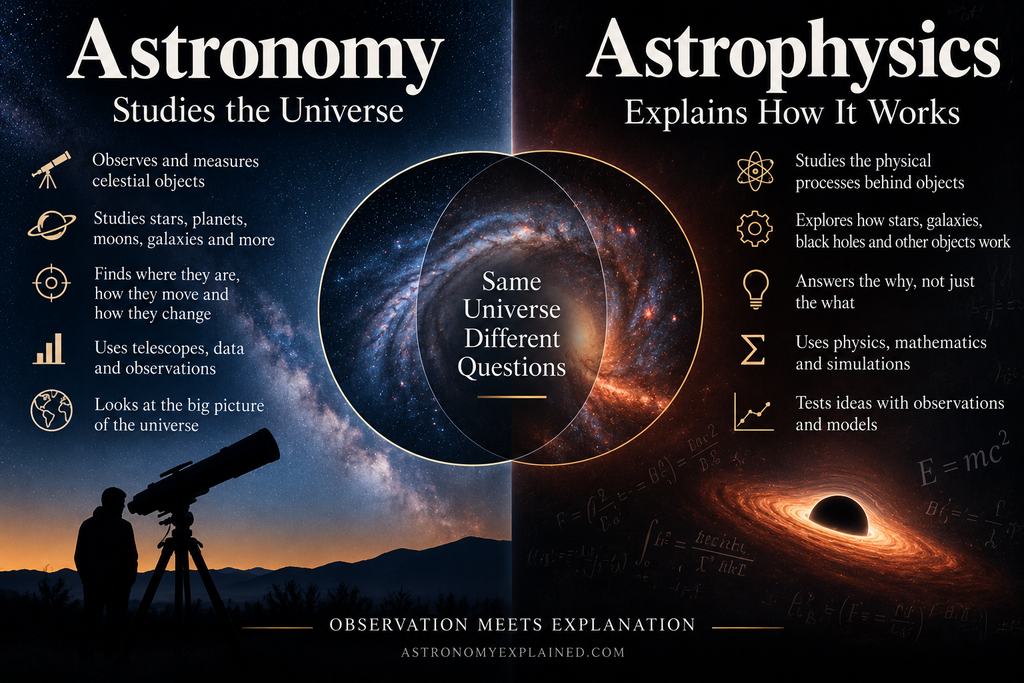
The simple answer is that astronomy is the broader study of objects and phenomena beyond Earth, and astrophysics focuses on the physical processes that explain how those objects work. Astronomers use physics and mathematics all the time, but astrophysicists rely heavily on observations from telescopes and other instruments. Basically, one observes, the other calculates, and they usually work together.
For example, the VISTA telescope at the Paranal Observatory in Chile conducted a large survey that began in 2010 and collected 500 terabytes of data over 13 years. Thanks to this, we mapped 1.5 billion celestial objects in our Milky Way Galaxy. The study was published in Astronomy & Astrophysics and involved astrophysicist Roberto Saito from Brazil’s Universidade Federal de Santa Catarina. This is a great example that the same scientists can do both; the overlap is quite a lot. You need observations to learn what is happening in the universe, and you need physics to understand why it is happening.
Let’s see what is the actual difference between astronomy vs astrophysics and go in detail.
Note: I used AI (LLMs) to create images for this blog post. They are mine but are generated via AI.
What Is Astronomy?
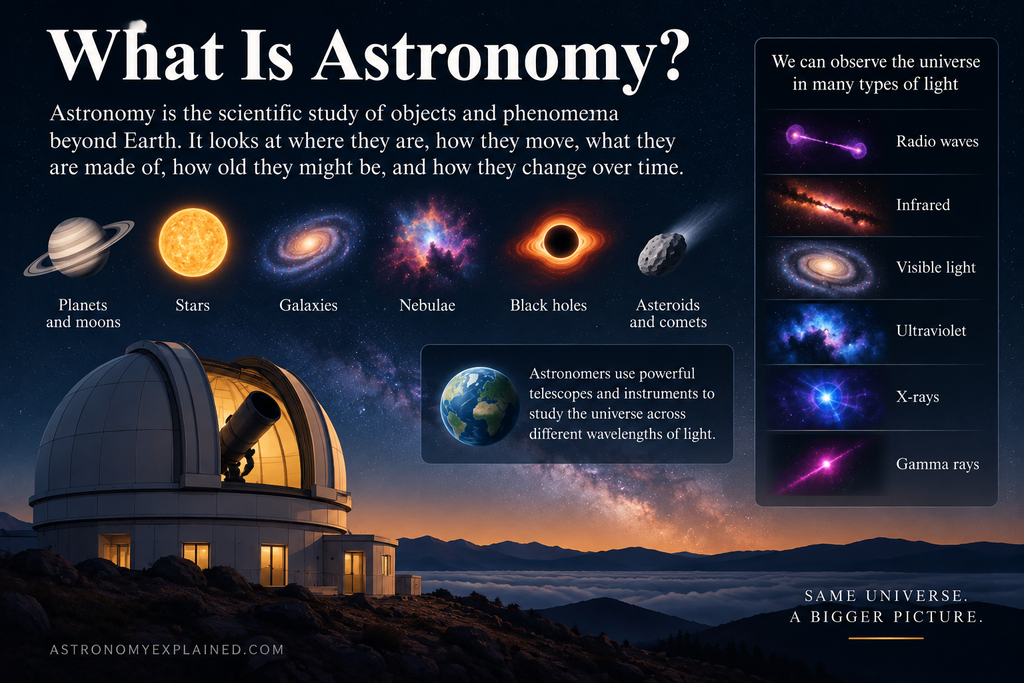
Astronomy is the scientific study of objects and phenomena beyond Earth. It covers almost everything we can observe in space, from nearby planets and moons to distant stars, galaxies, nebulae, black holes, and the large-scale structure of the universe.
Astronomers study many different properties of these objects. They may look at where an object is, how it moves, how bright it is, what it is made of, how old it might be, and how it changes over time. Since we cannot travel to these objects and examine them up close, astronomers use observations and measurements.
This is where telescopes come in. Modern astronomy uses much more than the typical telescope you might picture, with observatories like the European Southern Observatory’s Visca Telescope in Chile designed to detect different types of electromagnetic radiation. With these special telescopes, astronomers can study radio waves, infrared light, visible light, ultraviolet light, X-rays, and gamma rays. They can also combine these observations with other signals, such as gravitational waves and particles, to build a better picture.
What Do Astronomers Study?
There is no single type of object that all astronomers study. One astronomer might spend years studying planets in our Solar System, while another might focus on distant galaxies or the behavior of stars.
For example, an astronomer studying an exoplanet might watch for a small dip in the brightness of its star. If the planet passes between the star and the telescope, it can block a tiny amount of the star’s light. By studying how much the brightness changes and how often the event happens, scientists can learn about the planet’s size and orbit. That is astronomy, but it also leads naturally into astrophysics.
What Is Astrophysics?
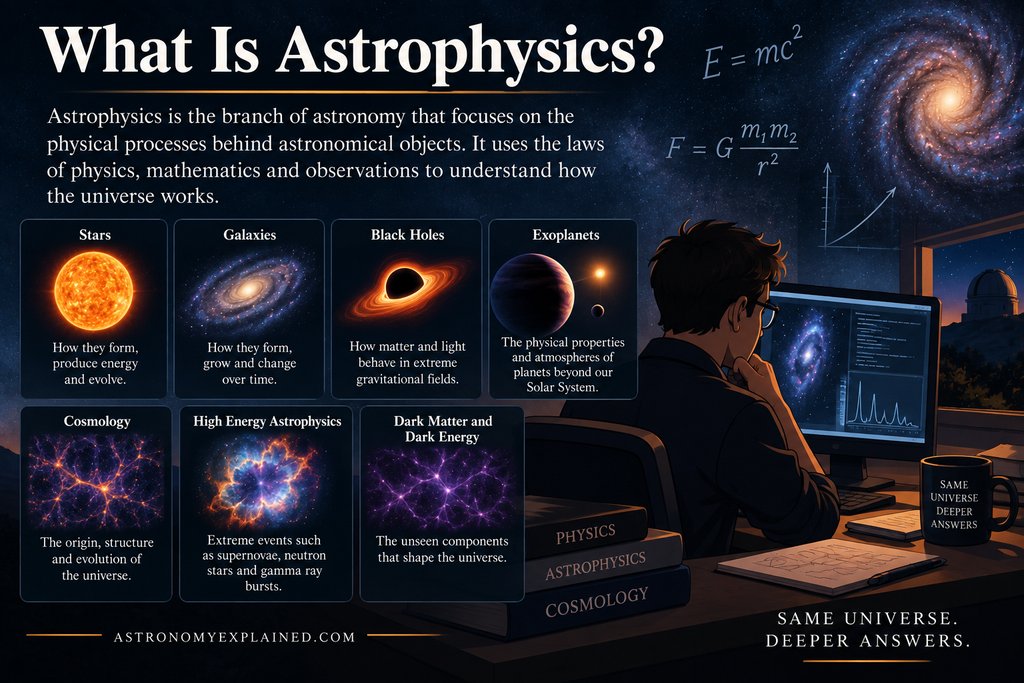
Astrophysics is a branch of astronomy that focuses on the physical nature of astronomical objects and phenomena. Instead of only asking what an object looks like or how it moves, astrophysics digs into the physical processes that make it behave the way it does.
Think about a star. An astronomer can measure its brightness, temperature, spectrum, and motion. An astrophysicist can use those measurements along with the laws of physics to study what is happening inside the star, how it produces energy, how its matter behaves, and how it will change over time.
Astrophysicists use many parts of physics during their daily work. Gravity, electromagnetism, thermodynamics, nuclear physics, and quantum mechanics are all parts of what they focus on, and these help explain different parts of the universe. They also use mathematics, computer simulations, models, and observations to test their ideas against what we actually see.
Main Areas of Astrophysics
Astrophysics covers a wide range of subjects because almost every astronomical object has some interesting physics behind it. Stellar astrophysics looks at how stars form, produce energy, evolve, and eventually die. Galactic astrophysics studies the physical processes that shape galaxies, including star formation, gas, dark matter, and the role of black holes.
There are also areas such as high-energy astrophysics, which looks at extreme events and objects such as neutron stars, black holes, supernovae, and powerful bursts of radiation. Exoplanet astrophysics examines the physical properties and atmospheres of planets outside our Solar System. Cosmology, which studies the origin, structure, and evolution of the universe as a whole, is also closely connected to astrophysics.
Astronomy vs Astrophysics: What Is the Difference?
The main difference between astronomy and astrophysics is the focus of the question. Astronomy is the broader study of what exists in space, how objects behave, where they are, and how we can observe them. Astrophysics puts more emphasis on the physical explanation behind those observations. They try to understand how they work, physically.
However, it would be misleading to say that astronomy is just observation and astrophysics is just theory. Modern astronomy uses physics, mathematics, statistics, and computer science to analyze observations. Astrophysicists also work with real telescope data because they need to test their physical models against observations.
This is why the boundary between astronomy and astrophysics can be hard to define. In some research projects, the two are almost impossible to separate. A scientist might observe a distant star, analyze its light, build a physical model of the star, and compare the model with the observations. That work could reasonably be called both astronomy and astrophysics.
Astronomy and Astrophysics Use Many of the Same Tools
Another reason the two fields are so closely linked is that they use many of the same tools. Telescopes collect information from distant objects, and computers help scientists process huge amounts of data. We use mathematics and statistics to identify patterns, calculate physical properties, and assess whether a result is likely meaningful.
The difference is often more about what the scientist is trying to learn from the data. An astronomer may measure the light from a distant galaxy and determine how bright it is or how fast it is moving. An astrophysicist may take those measurements and use them to investigate the physical processes that formed the galaxy or changed it over time.
In practice, you need both approaches. Observations give scientists evidence about the universe, while physics gives them a way to explain that evidence.
An Example: Studying a Distant Planet
Imagine that scientists discover a planet orbiting a star hundreds of light-years away. A telescope detects a small drop in the star’s brightness each time the planet passes in front of it. By measuring those changes, researchers can work out important details about the planet’s orbit and size.
That is where astronomy and astrophysics start to overlap. The observations can tell scientists that the planet exists and give them information about its orbit. Astrophysics can then help researchers explore questions about the planet’s temperature, atmosphere, composition, and interaction with its star.
The same research project can therefore involve both fields. There is no need to draw a hard line between the astronomer who gathers the data and the astrophysicist who explains it. In modern research, scientists often do both.
How Do Astronomers and Astrophysicists Work Together?
As you understand by now, astronomy and astrophysics often work as two parts of the same process. Scientists first need observations to find out what is happening in the universe. They can then use physical laws and models to explain those observations. If the model makes a new prediction, astronomers can look for evidence that supports or challenges it.
Black holes are a good example. We can observe the light and matter around a black hole and measure how nearby objects move. Astrophysicists can then use those observations to study gravity, radiation, magnetic fields, and the behavior of matter under extreme conditions.
The process can also work in the other direction. A physical model may predict that a certain type of event should happen, and astronomers can then search the sky for evidence of it. This back and forth between observation and theory is one of the reasons astronomy and astrophysics are so closely connected.
What Are the Main Areas of Astronomy?
Because astronomy is such a broad field, it has many different specialties. Observational astronomy focuses on collecting and analyzing data from telescopes and other instruments. Planetary astronomy studies planets, moons, asteroids, comets, and other objects in planetary systems.
Stellar astronomy focuses on stars and their properties, while galactic astronomy looks at the structure, contents, motion, and evolution of galaxies. Cosmology looks at the universe on the largest scale, including its origin, structure, and evolution.
Many of these areas overlap directly with astrophysics. Stellar astronomy, for example, can involve many of the same questions as stellar astrophysics. The names may differ, but the science is often very similar.
What Are the Main Areas of Astrophysics?
Astrophysics also has different areas based on the objects or physical processes scientists study. Names are almost the same as the areas of astronomy. Stellar astrophysics focuses on the physics of stars, including how stars form, produce energy, and change over time. Galactic astrophysics looks at the physical processes that shape galaxies and their contents.
High-energy astrophysics deals with some of the most extreme objects and events in the universe. Some of these are black holes, neutron stars, and supernovae. Exoplanet astrophysics studies the physical properties of planets outside our Solar System, including their atmospheres and interactions with their host stars.
Cosmology is another major area that is very close to astrophysics. It asks questions about the universe as a whole, such as how it began, how it has changed, how large-scale structures formed, and what the universe is made of.
Is Astronomy the Same as Astrophysics?
Astronomy and astrophysics are not exactly the same thing, but they are much closer than many people realize. Astrophysics is generally described as a branch of astronomy that focuses on the physical nature of astronomical objects and phenomena.
At the same time, modern astronomy is already deeply connected to physics. Astronomers need physics and mathematics to understand their observations, and astrophysicists need observations to test their models. This is why some universities and research groups use the terms astronomy and astrophysics together.
So if you are wondering whether one field is about observing while the other is about doing equations, the answer is no. Both fields can involve observation, physics, mathematics, statistics, and computer modeling.
Astronomer vs Astrophysicist: What Is the Difference?
If you are thinking from a career perspective, the difference can be more confusing. What do you need to know and what do you need to do as an astronomer or astrophysicist? An astronomer might spend a lot of time collecting telescope data, analyzing observations, studying celestial objects, or working with large astronomical datasets. An astrophysicist might spend more time building physical models, running simulations, or using mathematics to explain how astronomical systems behave.
Even then, there is plenty of overlap. An astronomer can work with advanced physics, while an astrophysicist can spend a large part of their career working with observations. The title a scientist uses can depend on their research area, university, or research institution.
In other words, you should not expect every astronomer to fit one job description and every astrophysicist to fit another.
Which One Uses More Math?
Astrophysics generally places a stronger emphasis on physics and advanced mathematics because it often involves building mathematical models of physical processes. Researchers may use equations to describe gravity, energy, radiation, motion, or the behavior of matter under extreme conditions.
That does not mean astronomy is light on math. Astronomers use mathematics to calculate distances, brightness, orbital motion, probabilities, statistics, and many other properties. Modern observational astronomy also relies heavily on computers and statistical methods to process large amounts of data.
What Is Cosmology, and How Does It Relate to Astronomy and Astrophysics?
Cosmology is the study of the universe as a whole. Instead of focusing mainly on one planet, star, or galaxy, cosmologists look at the large-scale structure, history, and evolution of the universe.
Cosmology has a close connection with astronomy and astrophysics because many of its questions involve gravity, matter, energy, space, and time. It uses observations of galaxies, the cosmic microwave background, and other large-scale features of the universe, along with physical models, to understand how the universe developed.
A simple way to picture the relationship is this: astronomy studies the universe and the objects within it, astrophysics focuses on the physical nature and processes behind those objects and phenomena, and cosmology looks at the universe on the largest scale.
Frequently Asked Questions
What is the main difference between astronomy and astrophysics?
Astronomy is the broader study of objects and phenomena beyond Earth. Astrophysics focuses on the physical nature and processes behind those objects and phenomena. In practice, the two fields overlap heavily, and many researchers work across both.
Is astronomy the same as astrophysics?
Not exactly. Astrophysics is generally considered a branch of astronomy, but the two fields overlap so much that the terms are sometimes used together. Both can involve observations, physics, mathematics, statistics, and computer modeling.
What does an astronomer do?
Astronomers study objects and phenomena in space. Depending on their specialty, they may collect telescope data, analyze observations, study celestial objects, develop instruments, or use computer models and statistics.
What does an astrophysicist do?
Astrophysicists study the physical processes behind astronomical objects and phenomena. An astronomer observes it, and an astrophysicist measures it (kind of). They can use observations, physics, mathematics, computer simulations, and models to understand how stars, galaxies, black holes, planets, and other objects behave.
Do astronomers use physics?
Yes. Modern astronomy uses physics, mathematics, statistics, computing, and other scientific tools. It is not correct to say that astronomers simply observe objects without using physics or mathematics.