If you have ever watched Doctor Who or a similar science fiction movie about space, you probably heard of parallel dimensions. It’s depicted differently in each movie or series; some are a copy of our universe where we made different decisions. Others are different universes completely. But what is a parallel dimension? There is a real version where scientists are discussing and checking for possibilities. The real idea behind parallel dimensions is that every decision made in the universe opens a separate universe where the decision that wasn’t made is made. Like, if you toss a coin and get heads, you created another universe (in quantum physics, a branch at the sub-atomic level) where you got tails.
Think about it, have you ever had that feeling that things could have gone completely differently? A different choice. A different path. A completely different version of your life is playing out somewhere else. What if it did? That’s the idea behind parallel dimensions, and there is a lot to say about it; it’s not a myth (mostly).
I will break it all down, talk about multiverse theory, the many-worlds interpretation, Schrödinger’s cat, and explain the concept of a parallel universe. What is a parallel dimension, and do parallel dimensions exist for real?
Note: don’t confuse this with alternate dimensions. They are vastly different things, and many people confuse them. If you are looking for that, check my alternate dimension article.
All theories discussed here reflect the current scientific literature as of 2026
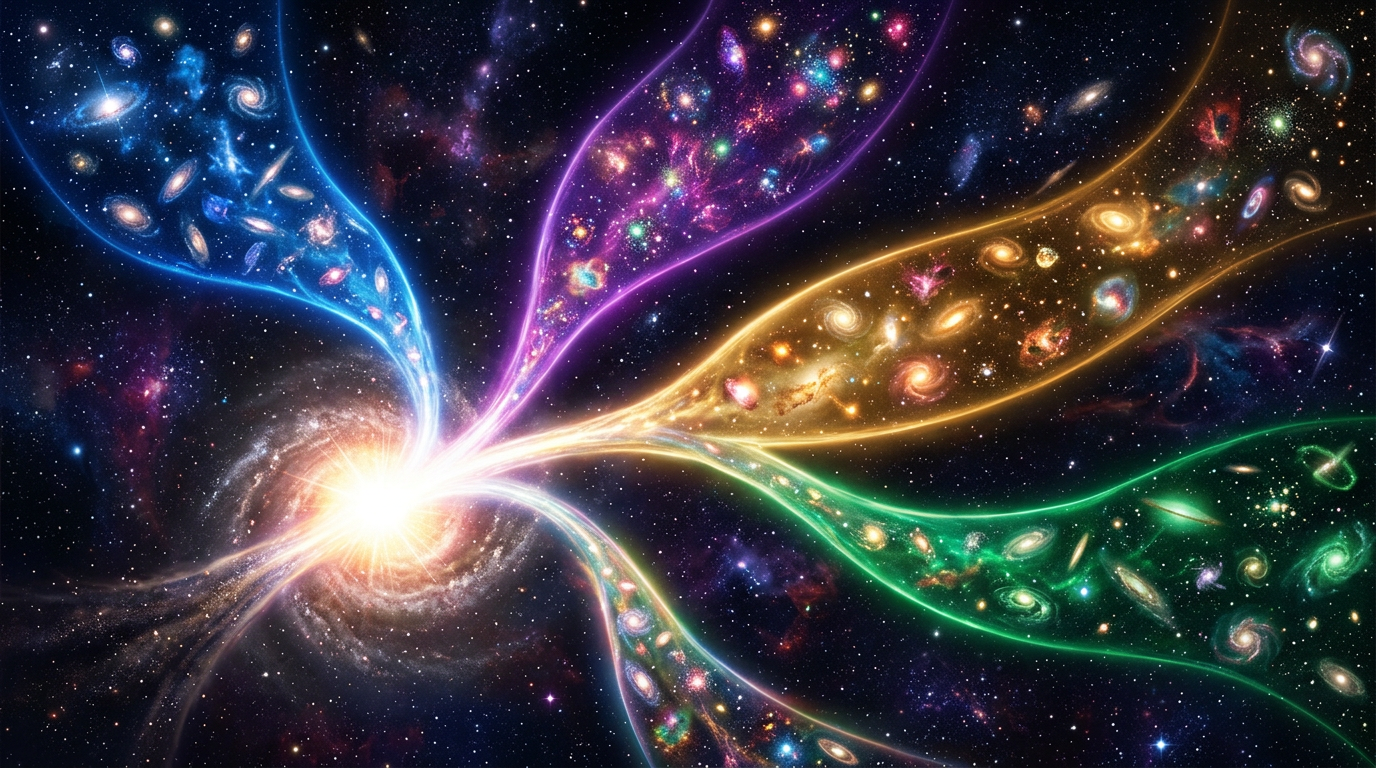
What is a Parallel Dimension, Really?
The word “dimension” gets mentioned so much that it’s easy to lose track of what it means. In physics, a dimension is simply a measurable direction in space. That’s it. You already live in three of them: length, width, and height (up-down, forward-backward, left-right). Time is the fourth dimension.
A parallel dimension (or, more precisely, a parallel universe or alternate reality) is a separate, self-contained reality that exists alongside our own. Pop culture has blended the two terms together so thoroughly that most people use them interchangeably. But that’s not true. A simple summary of them:
- Extra dimensions — hidden directions in space, too small to detect (the string theory route with multiverses)
- Parallel universes — entirely separate realities, each with its own laws and history, created by every time a decision was made (or whenever there was another chance, something else could have happened)
Both get called “parallel dimensions” depending on who you’re asking.
The Idea is Way Older Than You Think
Funny thing is that the parallel dimension idea is not a modern concept. It has been here since 1884, when Edwin Abbott wrote a book called “Flatland.” It’s a story about a two-dimensional world where the inhabitants literally cannot conceive of “up” or “down.” When a 3D sphere passes through their world, it appears as a circle that grows and vanishes. To them, it’s magic. To us, it’s obvious that there’s just a dimension they can’t see.
Abbott didn’t write it as something to quote as a scientific paper, but the message was funny enough to be taken seriously. Physicists have quoted it for 150 years because maybe we’re the Flatlanders. Maybe there are directions in space we simply can’t perceive. Then Einstein showed that space and time aren’t separate things. They’re one fabric, spacetime, and it bends and warps around massive objects. Once you accept that, asking about the possibility of dimensions we can’t see starts becoming physics.
Three Scientific Theories That Point to Parallel Dimensions
The idea of parallel dimensions is not one specific route. There are several possibilities that may create parallel dimensions. The basic point of it is very similar (even the same), but how you get there is different. There are three main theories: the many-world interpretation (in quantum mechanics, which is one of the most probable theories as it goes down to the smallest particle we have ever observed), string theory’s extra dimensions, and eternal inflation and multiverse. Keep in mind that two of these (Many-World and Eternal Inflation) is essentially a parallel universe theory but supports the idea of parallel dimensions, as well.
1. The Many-Worlds Interpretation of Quantum Mechanics
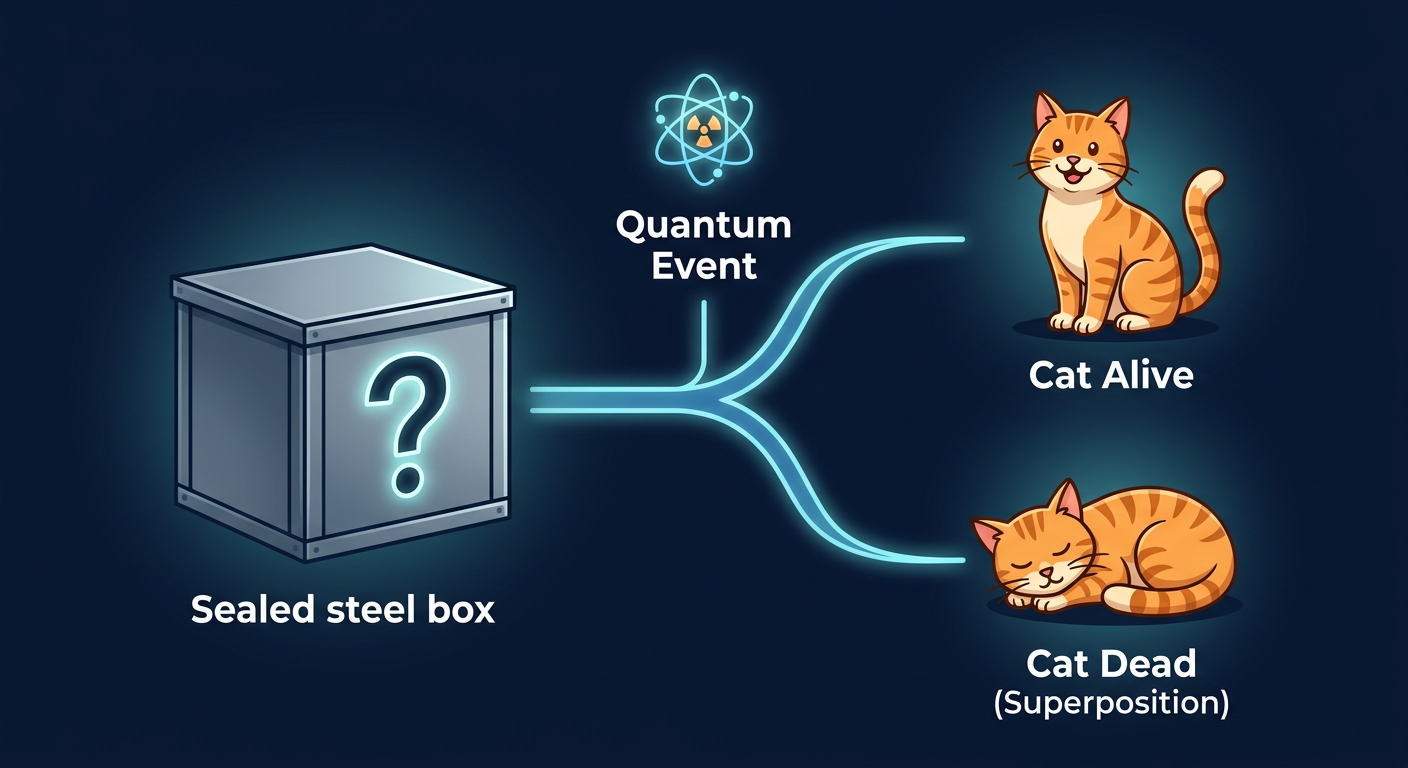
Schrödinger’s cat is basically a way to explain the many-world interpretation. Imagine a cat is in a sealed box with a radioactive atom. If the atom decays, the cat dies and if it doesn’t, the cat lives. According to quantum mechanics, until someone opens the box, the atom is in both states at once. Decayed and not decayed. Which means the cat is technically both alive and dead at the same time.
What it essentially says is that until an atom is observed, it is in every possible state (we call this superposition). You will never know which state you are going to observe until you observe. The moment you observe, the universe splits into two (or however many possibilities there are), where every possible state happens. In one universe, the cat dies; in the other, it doesn’t. One universe was created the moment the other possibility happened in one universe. This continues with everything happening, new universes being branched and created.
That’s the Many-Worlds Interpretation. There are versions of you who never started reading this. Versions of you living completely different lives. Note that this is different than the multiverse. A multiverse is where there are endless universes created at the same time, and each has different stuff or is very similar. I’ve talked about whether the multiverse theory is proven or real in another article; check it out.
Another important note is that, according to our current knowledge, those branches can never communicate with each other. You’ll never meet your parallel self, but according to Everett, they’re out there.
2. String Theory and Extra Dimensions
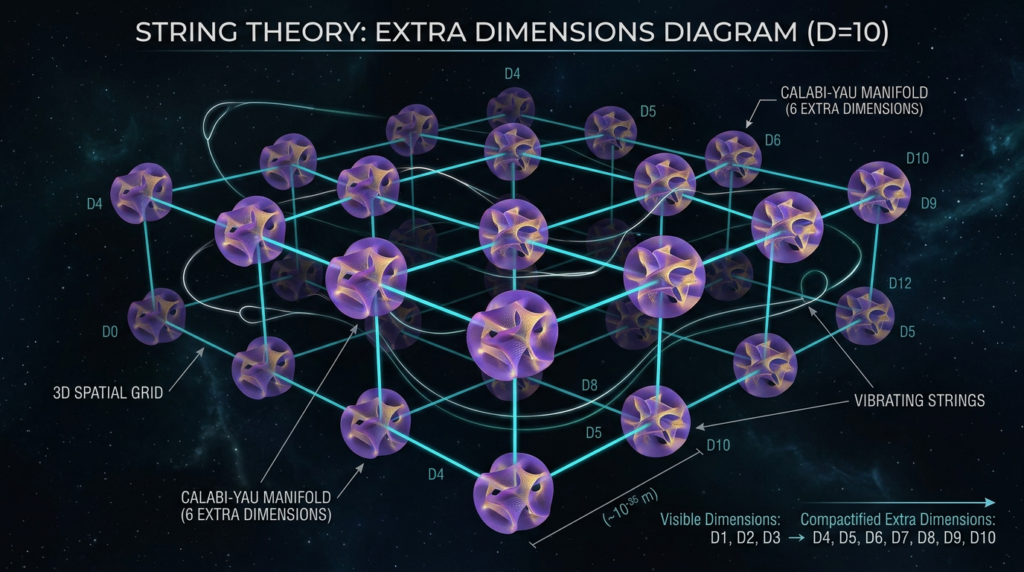
String theory is physics’ most ambitious attempt to explain everything. The core idea: the smallest building blocks of reality aren’t tiny particles, they’re tiny vibrating strings of energy. Different vibrations = different particles. Like different notes on a guitar string. In essence, it’s not too complicated, but it gets confusing when you see where the equations work. When you do the full maths on string theory, the equations only work if the universe has 10 or 11 dimensions. Not four. Ten. So where are the other six or seven?
They’re compactified, curled up so impossibly small that no instrument we’ve ever built can detect them. Think of a garden hose from far away: it looks like a 1D line. Walk closer, and you see a whole circular dimension wrapped around it. String theory says every point in space has six extra dimensions coiled up just like that, just way, way smaller. According to NASA’s overview of the structure of the universe, we can only observe a fraction of what may physically exist.
You can arrange those extra dimensions in an enormous number of ways that each creates a universe with different physical laws. That’s why string theory and the multiverse get talked about together so often. In some versions of string theory, other universes aren’t just possible, they’re practically unavoidable.
3. Eternal Inflation and the Multiverse Theory
The third route to parallel dimensions comes from the Big Bang itself. The leading theory of the early universe includes something called cosmic inflation. It’s the idea that in the first tiny fraction of a second after the Big Bang, the universe expanded at an insane rate, doubling in size repeatedly before settling down. This is the acknowledged theory about our universe, and it also explains the observable universe, why there is a limit to what we can see. If you are interested about what is the observable universe, I have a detailed article about it.
The part that many overlook is that in most mathematical models of inflation, it doesn’t just happen once and stop. It keeps going, forever, in most of the space. Some theories suggest that the Big Bang was not a one-off event. It happened and happens, and every time it happens, it creates a bubble universe that keeps expanding continuously. A bubble universe is a self-contained cosmos with its own Big Bang, its own physical laws, its own potential for stars and planets (the multiverse). Our entire observable universe is just one of those bubbles, as the theory says. This is another view of parallel dimensions. It’s where each universe is not connected to the others. Many scientists find this more unlikely than the first theory.
How Real are Parallel Dimensions?
The direct answer is that we don’t know. Primarily because all the theories I mentioned, and others, are just theories. Physicists and scientists are working on them, and when they find related pieces that may be true, they consider them more serious than others. We didn’t rule any one of them out because, well, none of them has direct or indirect evidence. If our thinking is correct, the main problem is that parallel dimensions are cut off from us. You can’t send a probe there. You can’t receive a signal. Every test must be indirect, which makes falsifying these ideas incredibly hard.
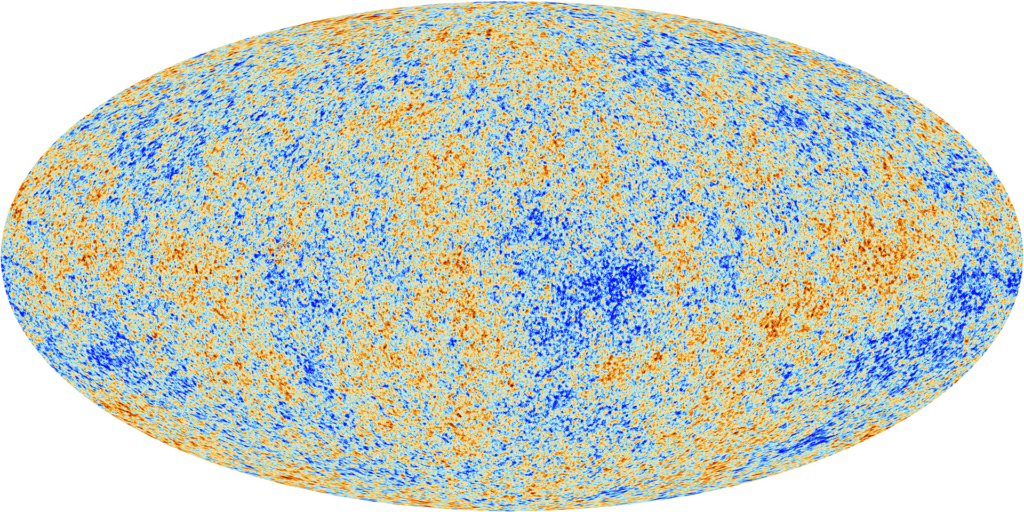
The best shot we have is the Cosmic Microwave Background (CMB), a faint afterglow of the Big Bang, visible in every direction of the sky. If our universe ever collided with a neighboring bubble during inflation, it might have left a bruise-like imprint on the CMB. Physicists have looked for this. So far, nothing is conclusive. But, according to NASA’s WMAP research on inflation, the CMB remains our most powerful observational tool for probing what happened in the universe’s earliest moments.
One of the pop culture shows that depicted the idea of parallel dimensions best is the show Dark Matter. It’s a fictional show (the original was a book, so if books are your thing, the name is the same) where a scientist figures out how to travel between these parallel dimensions. But it focuses on the first theory, the quantum one.
Conclusion
So, what is a parallel dimension? It’s a concept that sits right at the edge of what science can currently test and also can’t see to prove it. Within the idea of parallel dimensions, there are several theories on how they can be real, like the Many-Worlds Interpretation, the hidden extra dimensions of string theory, or the bubble universes. The main point of what is a parallel dimension is that we may not be alone. There may be other versions of us or other realities that we can’t see and probably won’t be able to see at all. An important thing to always remember is that we don’t know. There is no direct or indirect evidence that any of these is real. The math says they do, but we need some sort of evidence to say it’s real.
Want to Keep Going?
If this got you thinking, these posts could be worth your time:
FAQ
What is a parallel dimension?
A parallel dimension is either a hidden direction in space beyond the three we experience (as in string theory) or a separate reality running alongside our own (as in the Many-Worlds Interpretation or the multiverse theory). Both ideas are grounded in real physics, though neither has been proven yet.
Do parallel dimensions exist?
We don’t know for certain because there is no direct observational evidence. However, the theories we talked about (the Many-Worlds Interpretation, string theory, and eternal inflation) can be one of the ways to get evidence. Physicists are actively searching for indirect clues in the Cosmic Microwave Background.
What is the Many-Worlds Interpretation?
The Many-Worlds Interpretation is a theory in quantum mechanics proposed by Hugh Everett III in 1957. According to Hugh Everett III’s 1957 paper, every time a quantum event occurs, the universe splits into separate branches. Each of those branches represents a different outcome. All branches are equally real, but they can never interact with each other.
How does string theory relate to parallel dimensions?
String theory requires the universe to have 10 or 11 dimensions to work mathematically. The extra dimensions beyond our familiar four are thought to be compactified. They are too small to detect. Different configurations of these dimensions could produce universes with completely different physical laws, effectively creating a vast landscape of parallel universes.
What is eternal inflation, and how does it create parallel universes?
Eternal inflation is the theory that cosmic inflation, the rapid expansion of the early universe after the Big Bang, never fully stops. In most of the space, inflation continues forever. Occasionally, regions stop inflating and collapse into self-contained bubble universes. We think our observable universe is one of these bubbles, and there are countless others potentially existing beyond what we can ever observe.