Wormholes and black holes have a solid hold in pop culture. Almost every sci-fi movie and show that talks about space will mention either both or one of them. Are they the same thing, though? Not at all, a wormhole vs black hole are very different things. Sometimes, as theories suggest, they may act like portals to somewhere else (we don’t think that’s real for black holes but some theories suggest it), but that’s about it in terms of similarities.
Check this article out, too: Article Dimension: Are They Real?
Historically, they share the same mathematical DNA, coming from Einstein’s equations of general relativity. Black holes are proven, an area that is stronger than everything else, even gravity, eating up whatever comes. Wormholes are only theories; there is no proof that they really exist. To an astrophysicist it may seem ridiculous to compare wormhole vs black hole but to someone who is learning things, it’s important to learn the difference. Plus, I like it.
What Is a Black Hole?
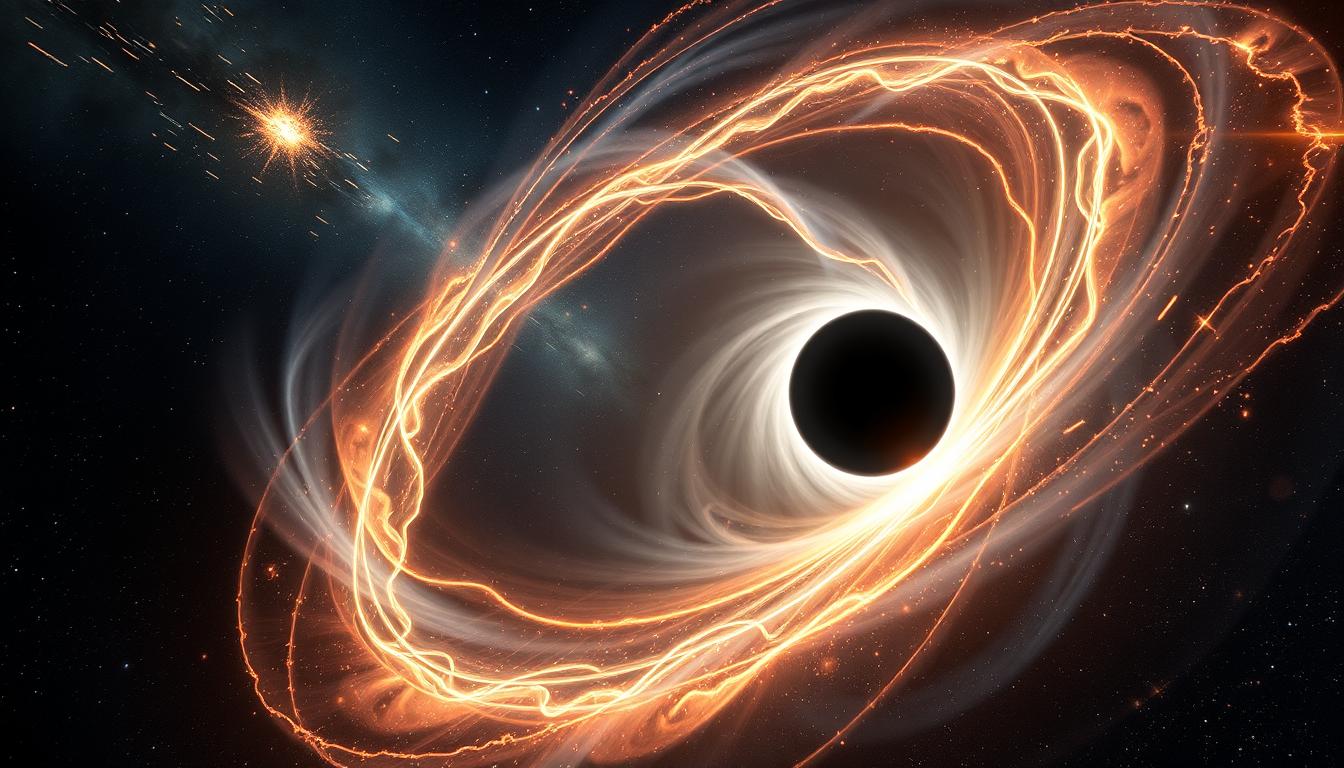
Before comparing them, brief overview what is a black hole and what is a wormhole. I’ll get to the wormhole after this. A black hole is exactly what it sounds like: a hole in space where gravity is so strong that nothing, not even light, can escape. This is the textbook description of a black hole. I have a ton of articles on black holes, so I don’t want to go too deep in this. Essentially, black holes were stars before they became this; they die, explode, and pack so much pressure in a tiny space that it starts eating out everything.
Most black holes start their lives as massive stars, at least 20 times heavier than our Sun. They live fast and die young, burning through their nuclear fuel in a few million years. When the fuel runs out, the star’s core can’t support itself against gravity. The core explodes, creating a supernova. If the remaining core is more than about three solar masses, gravity wins completely. The collapse continues forever, and the matter gets crushed into infinite density. This makes the black hole. There are different types of black holes, like supermassive black holes (some of the biggest ones that usually sit at the center of a galaxy, including ours).
The most important thing to remember about black holes is that we have direct evidence. The Event Horizon Telescope captured the first direct image of a black hole’s shadow in 2019. LIGO and Virgo detected gravitational waves from a black hole merger. We can see stars orbiting an invisible area at the center of our galaxy. This is direct proof of the presence of a supermassive black hole.
The Anatomy of a Black Hole
We categorize black holes by their distinct parts. We can’t see most of them, just their probable structure, including theoretical work in places that it’s not physically possible to check.
- Event Horizon. This is the famous point of no return. It’s not a physical boundary, but rather mathematical. Beyond the horizon, the pull of the black hole gets so strong that you can’t escape. You can’t come back. The only way out is to travel faster than light. So far, that’s impossible. Stuff falls in, nothing comes out.
- Singularity: This is mostly the guesswork part (or mathematical guess). We believe that at the center of a black hole, after you go beyond the event horizon, there is a singularity. It’s where all the mass is concentrated. We don’t really know what happens there because our equations stop making sense.
- Accretion Disk: Before matter falls in, it forms a glowing, superheated disk spiraling around the black hole. Friction heats this gas to millions of degrees, making it glow. This is how we “see” black holes. If you saw the famous black hole picture from 2016, that’s the orange-ish light.
- Photon Sphere: Outside the event horizon, there is a region where light can orbit the black hole in unstable circles. If you could stand there, you’d see the back of your own head as light loops around.
What Is a Wormhole?
Now let’s talk about the wormholes that probably don’t exist or that we won’t find or create in our lifetimes. A wormhole is a theoretical tunnel through spacetime that connects two separate points, potentially allowing you to travel between them much faster than light could through normal space. You enter from one end, and you exit from a random spot in space.
The idea is essentially coming from the same mathematical solution that describes a black hole, Einstein’s equation, the Schwarzschild solution. When Einstein and his colleague Nathan Rosen studied these equations in 1935, they realized the math allowed for a “bridge” connecting two regions of spacetime. This became known as the Einstein-Rosen bridge, the first theoretical description of a wormhole.
Originally, they thought this bridge connected a black hole to a “white hole“, a theoretical object that expels matter but never allows anything to enter. A white hole is the time-reversed version of a black hole. Among many things, white holes probably don’t exist. They violate the second law of thermodynamics, and there is no direct proof. Funny thing is, there are theories that say that inside a black hole, there is a wormhole instead of a singularity. So anything that goes in travels somewhere else. But they are not very reliable theories.
Problems With Wormholes
Perhaps the most important distinguisher is that wormholes don’t have direct proof. We don’t know if they exist or are even possible. Our current mathematical calculations say that they may exist. “May.” There is zero observational evidence. We’ve never seen anything that looks like a wormhole mouth. We’ve never detected the exotic physics they’d require. We are not even sure that the thing that creates a wormhole, exotic matter, exists in the entire universe.
Wormhole vs Black Hole: Comparison
Probably now that you have a bigger picture of what they are individually, you know the main differences and it became easier to understand the differences with wormhole vs black hole. The differences are pretty big, different things. Like, one is a Bugatti car, and the other is the Noch Less monster. Bugatti is real and powerful, but it is very rare to see one. Noch Less is just a story.
One-Way vs. Two-Way Traffic
This is the most obvious difference. When you enter a black hole, there is no leaving. Once you pass the event horizon, you travel faster than the speed of light, so with our current physics, you can’t get out. There’s no exit, no escape, no return ticket.
A wormhole, in theory, is a two-way tunnel. You could enter one mouth, travel through the throat, and emerge from the other mouth. You could even turn around and go back through. It’s a passage, unlike a black hole. This fundamental difference is why wormholes are so famous in science fiction.
Singularity vs. Throat
Black holes end in a singularity, a point of infinite density where spacetime becomes infinite, and our equations break down. It’s a dead end, literally and figuratively. We don’t have proof of the inside of a black hole, though. In my opinion, we will never have it.
Wormholes, at least in their idealized form, don’t have singularities. Instead of ending in a point, they have a throat that connects to another mouth. The curvature is extreme but finite. You could theoretically pass through without being crushed into oblivion (though you’d face other lethal problems).
Stability and Lifespan
Black holes are remarkably stable. Once they form, they can last for billions of years, slowly evaporating via Hawking radiation (I have another article explaining this). A solar-mass black hole would take 10^67 years to evaporate completely. They are there until eternity, they will be the last things to stand in the whole universe.
Wormholes are (theoretically) unstable. Without exotic matter holding them open, they’d collapse right away. It would be so fast that it’d be faster than light could even travel through them. Math allows them, but physics doesn’t seem to provide a way to keep them alive.
Observational Status
This is the most important difference in the wormhole vs black hole discussion because this sets the reality. Black holes are real. We know them, we observe them. We have a direct image of a black hole, and we detected gravitational waves from black holes merging. There is much other direct and indirect evidence that leaves no guesswork behind about their existence.
On the other hand, wormholes are not real. There is no direct or indirect evidence of wormholes. We never observed one, we didn’t detect any gravitational wave or other type of special signature to prove they exist. They live in theoretical boards and possibilities. I don’t think this is going to change anytime soon.
Exotic Matter Problem: Why Wormholes Fail the Reality Test
In the wormhole theory, currently, the biggest obstacle to the existence of wormholes is exotic matter. Exotic matter is a fundamental requirement for a wormhole to be created. I’m not talking about keeping it open or anything, just to make it happen. But exotic matter doesn’t exist. At least we haven’t observed it yet.
What Is Exotic Matter?
Exotic matter is matter with negative energy density. Normally, energy is positive. E=mc² tells us that mass and energy are equivalent and both are positive. But exotic matter would have negative energy according to our calculations. It’s the opposite of normal matter.
Why do wormholes need this? Think of the wormhole throat as a tunnel being squeezed by its own gravity. The throat wants to collapse in on itself, just like any massive object would. To counteract this inward pull and keep the tunnel open, you need a repulsive force. Exotic matter provides that through its negative energy density. It’s like anti-gravity.
However, this (as you may also imagine) is a big issue. All known matter (atoms, photons, dark matter, and everything else) has positive energy density. That’s why we never observed exotic matter. The Casimir effect in quantum mechanics can create tiny pockets of negative energy between two closely spaced plates, but these are small and fleeting. You can’t scale them up to macroscopic wormhole sizes.
The amounts needed to open and stabilize a traversable wormhole would be enormous. You’d need negative energy equivalent to the mass of a planet, concentrated in a tiny region. There’s no known mechanism in nature that could create or sustain this.
The Instability Issue
Let’s say that somehow you observed or created exotic matter and used that to create a wormhole. Great, you passed the first test. Now the next question is, how do you make that stable? How do you keep it open so that stuff can travel? Because the one you create with a small amount of exotic matter would be incredibly fragile. Any disturbance (a photon passing through, a ripple in spacetime, anything) would collapse it. The wormhole would either snap shut, trapping you inside, or explode into two singularities.
The answer to this is either more exotic matter or something else. We don’t know what that something else may be. As I said before, you probably need exotic matter the size of a planet or something. Too much.
The Black hole=Wormhole Theory
For some time, there have been discussions about the possibility of black holes being wormholes. Like, instead of the singularity at the bottom of the black hole, there is a wormhole that you travel through. You’d enter from one black hole and exit from another. The reality is that even though it’s a fun theory, I’m not sure how well it holds up in practice. First and foremost, there is no way we can know this. There is no way to prove or disprove it, like the singularity. Secondly, singularity theory is more realistic from a mathematical perspective than Einstein’s equations.
Some also say that maybe we are misidentifying wormholes as black holes. Maybe those supermassive black holes at the centers of galaxies are wormhole mouths. This is less realistic in the theoretical scheme. The whole reason why this second theory came up was because of an idea. Some researchers saw that under very specific, idealized conditions, a wormhole could produce gravitational signals similar to a black hole. The vibrational frequencies of spacetime could be nearly identical. From a distance, you might not be able to tell them apart. That’s why we made the assumption that maybe black holes are wormholes.
Why This Is Probably Wrong
The idea and the theory seem nice, but there is a reason why physicists are skeptical of black holes as a wormhole theory. This only works for idealized, static, non-rotating black holes. Real black holes rotate (they have angular momentum), have accretion disks, and emit Hawking radiation.
More importantly, there’s no known mechanism for a collapsing star to create a wormhole. Creating a wormhole would require the precise arrangement of exotic matter at the moment of collapse. As you know, exotic matter doesn’t exist, how can it be created if we didn’t observe it before? You can’t get a wormhole from normal astrophysical processes.
The white hole problem is another problem. Wormholes require white holes as exits, and white holes violate the second law of thermodynamics. They’d decrease entropy, which is like watching a broken egg spontaneously reassemble. Entropy never goes down; it always increases until it reaches equilibrium.
Conclusion
Comparing wormhole vs black hole is quite simple because a black hole exists whereas a wormhole is only a theory. Black holes are what’s left of massive stars that die. They lose to the immense amount of gravity and become black holes. We know this. We observed black holes, took a picture of one, and saw the indirect effects of them on other things in space, like with their gravitational waves. There is no question whether they exist. There are questions about what happens when you enter a black hole, what’s at the bottom of it, and so on.
Wormholes, on the other hand, are theoretical and unobserved. There is no direct or indirect evidence that they exist. Even in paper, to have a wormhole, we need exotic matter. We never even encountered this matter. So, we don’t even know how to make or what the core matter is that makes wormholes. Even if we can make very little to open it, we need the same mass as a planet to keep it stable. The idea is nice, you can travel in spacetime when you go through it, but there is nothing to back it up.
FAQ
What is the main difference between wormhole vs black hole?
The core difference lies in their nature and function. A black hole is a region of space with such intense gravity that nothing, not even light, can escape its pull. It’s a cosmic dead-end. A wormhole is a theoretical “tunnel” or bridge in spacetime that could potentially connect two points or even different universes, like an elevator.
Is time travel possible through a wormhole?
In theory, certain types of wormholes could act as time machines. If one end of the tunnel moves at near-light speed or is placed in a strong gravitational field, time would pass differently at each entrance. This could create a pathway to the past or future. But this idea has even more problems. If it’s true, though, we’d travel in spacetime. Check the Adam Project movie, it was a surprisingly fun and sort of accurate one.
What would happen if a black hole and a wormhole collided?
The outcome depends on size and stability, but the most likely result is that both would collapse into a larger black hole. If the wormhole were somehow stable and larger than the black hole, the black hole could pass through it. But the black hole’s immense mass would destabilize the wormhole’s structure. The wormhole would collapse.
How can we definitively prove wormholes don’t exist?
By mathematically challenging the current theoretical evidence. We look for patterns that distinguish a wormhole from a black hole. So far, all observations match black hole predictions. Theoretical work also shows that wormholes require exotic matter that violates known physics.