If you open any sci-fi movie about space or astrophysics, there is a likelihood that you will see a mention of an alternate dimension on it. They are everywhere, and both scientists and hobbyists in astrophysics are interested in alternate dimensions. Superheroes slip between realities, parallel universes fork off at every decision, and hidden worlds exist just beyond our perception. It’s the ultimate creative sandbox. But how real are those depictions? Is there a scientific background to it, really? Are alternate dimensions real? What is the difference between parallel universes and alternate dimensions?
Check this article out, too: Do Black Holes Evaporate? Are They Always There?
Alternate dimensions and parallel universes are two different things. You will mostly see them shown as the same things, but they are not. One involves hidden spatial directions curled up impossibly small (alternate dimensions). The other is separate universes with their own space and time (parallel universes). Among many other things, both are largely unproven. The science backs it, though.
What Do We Mean by “Alternate Dimension”?
The word “dimension” gets thrown around so loosely in pop culture that it’s easy to get confused. When someone says “alternate dimension,” they might mean a secret universe hidden in plain sight, or they might mean a direction in space we can’t perceive. In physics, these are fundamentally different ideas. But there is only one meaning for an alternate dimension in astrophysics.
Dimensions as Directions in Space
Start with what you know. Right now, you can move in three directions: left-right, forward-backward, and up-down. These are the three spatial dimensions of our everyday experience. Time acts as a fourth dimension, moving from the past to the future. Together, these four dimensions (three space, one time) make up spacetime. However, there is nothing specific that states that the universe must have three spatial dimensions. Mathematically, spacetime could have four, five, or even dozens of spatial dimensions. We just wouldn’t notice them because we’re bound to our three-dimensional reality.
Think of an ant crawling on a sheet of paper. The ant experiences a 2D world; it can move left and right, and forward and backward, but “up” to the ant means off the paper entirely. If another ant were crawling on top of a second piece of paper above the first, the ground-ant would never perceive it. The two ants exist in mathematically similar 2D worlds, but they’re separated by a direction the ground-ant can’t access. We know and see three dimensions, and we may not perceive other dimensions.
Dimensions as Parallel Universes
When alternate dimensions come up in pop culture, they usually mean separate realities. A parallel universe is another version of spacetime, with its own space and time, existing independently of ours. It’s not a hidden direction; it’s a complete, separate universe. One of the theories about parallel universes is that when someone makes a decision, there is a new parallel universe that pops up (called Many-World Interpreration, see below) . Each parallel universe is essentially a version of our universe that didn’t exist. In essence, an alternate dimension is another dimension in our universe, a parallel universe is a completely different universe.
Extra Spatial Dimensions: The Hidden Fabric of Reality
Where did the idea of more dimensions, an alternate dimension, come up? Why did we even start thinking about an extra dimension? Because of unification. Imagine standing in a room with four light switches, each controlling a different light. One switch controls gravity, another electromagnetism, a third controls the strong nuclear force, and the fourth controls the weak force. These four forces look separate. They have different electronic connections, behaviors, and rules. But scientists always suspected that there is a master switch somewhere. Idea of that these four light switches are manifestations of something unified.
Why Would Extra Dimensions Exist?
In the 1860s, James Clerk Maxwell demonstrated that electricity and magnetism weren’t separate, but rather two manifestations of the same electromagnetic force. The goal is to find a unified framework where all forces fit together. String theory has a solution that says that the universe isn’t made of particles. It’s made of tiny vibrating strings. Every particle (electrons, photons, quarks, everything) is just a vibration of the same string.
The problem is that three spatial dimensions aren’t enough for strings to vibrate in all the ways needed to produce all the particles we observe in nature. With three dimensions, you can’t generate enough distinct vibration patterns to explain the full variety of matter and forces. So string theory requires extra spatial dimensions. Modern versions predict either 10 or 11 total spatial dimensions, depending on the formulation.
Where Are These Hidden Dimensions?
If the fourth or way more alternate dimensions exist, where are they? Why haven’t we bumped into them? Is there a way to see them? Like unification, compactification could be the answer for this question. Imagine a garden hose lying on the ground. From far away, it looks like a 1D line. Step closer and you see it has a circular cross-section. It’s 2D; there’s a second direction wrapped tightly around it. Similarly, physicists propose that the extra spatial dimensions are curled up into such tiny structures that they’re undetectable. They exist everywhere, but at scales so small, potentially around 10^-33 centimeters (the Planck scale), that we don’t have the right experiment to see them.
The universe would be like a rope hanging in the distance. To your eye, it appears to be a one-dimensional line. But up close, it’s a cylinder; it has an extra curled-up dimension. Everything in the universe would be threaded through these extra dimensions constantly, but we’d never notice because the dimensions are so microscopically tiny that they’re effectively invisible.
The Kaluza-Klein Revolution
Something that connects well to compactification is Theodor Kaluza’s experiment. He added a fifth spatial dimension to Einstein’s equations, and the equations produced electromagnetism. Kaluza had unified two of the four fundamental forces by adding a dimension. However, Kaluza didn’t know what this fifth dimension was or why it would be hidden. Physicist Oskar Klein thought that it must be compactified (see above). We now call this the Kaluza-Klein theory, the template for modern unification efforts.
Today’s string and M-theory physicists are essentially pursuing the same strategy Kaluza started: adding more dimensions to the mathematical description of spacetime. But like other theories, it’s just a theory. Whether it’s actually, physically true, we don’t know.
String Theory and the Many-Dimensional Universe
The theory that first brought the idea of an alternate dimension and that there should be extra spatial dimensions is string theory. It’s the framework that gave us the source to start diving deeper into understanding alternate dimensions.
Why Strings Need Extra Room
Traditional physics views the universe as composed of point particles, such as electrons, quarks, and photons. Each one is infinitely small, a dot with no internal structure. String theory replaces this with strings. These are one-dimensional objects that vibrate in different ways, and the way they vibrate determines what kind of particle we perceive.
This has a fundamental problem. In three spatial dimensions, strings can only vibrate in a limited number of ways. Some vibration modes naturally correspond to familiar particles: one mode looks like an electron, another like a photon. But the complete Standard Model of particle physics contains far more particles than three dimensions can “generate.” You’d be missing particles that should exist.
When you add extra dimensions, you have room for more vibration modes. Ten or eleven dimensions provide just enough “space” (mathematically speaking) for strings to vibrate in ways that produce all known particles and gravity. There is no other theory that incorporates this.
Parallel Universes: Alternate Realities Beyond Our Own
In the beginning, I mentioned that parallel universes and alternate dimensions are different things. I talked a lot about what is an alternate dimension and detailed it down and I will continue. I think now, it’s good to stop and talk a little about parallel universes. It will help you draw that picture better and understand the actual differences. That way, all of what I am talking about will make more sense (I hope). As I said, parallel universes are separate universes, each with its own spacetime, existing alongside our own. There are many different theories surrounding parallel universes, such as alternate dimensions. There is the Many-Worlds Interpretation, bubble universes, multiverse, and so on. Let me just explain the most popular ones.
The Many-Worlds Interpretation
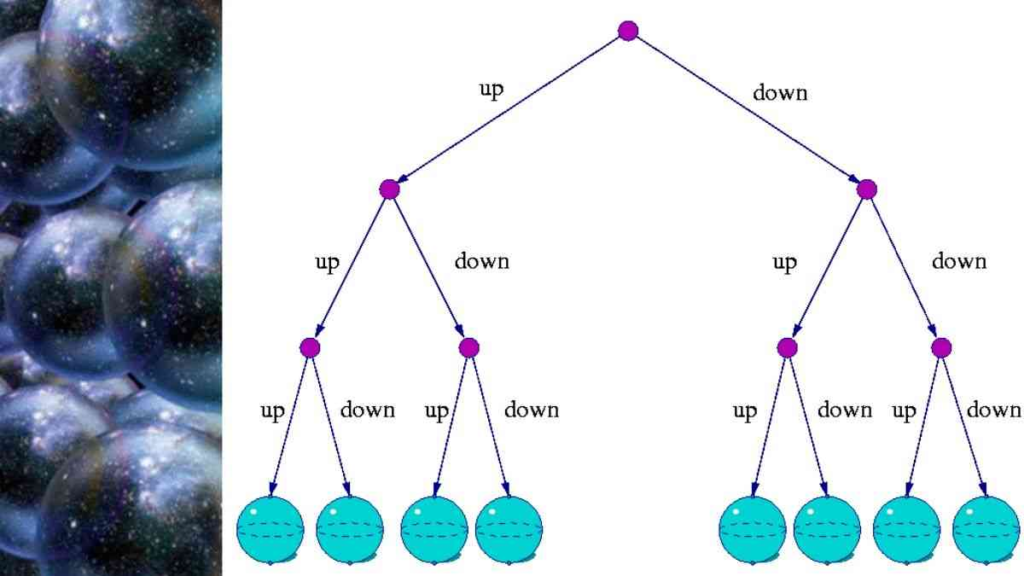
Many-Worlds Interpretation is fundamentally working on quantum mechanics principles, on the subatomic level. If you know a little about how that works, essentially, before you measure an electron’s position, it’s “in superposition“. It means that an electron, when we are not observing it, exists in multiple places at once. The moment you measure it, the universe branches into different versions where all the possibilities happen.
One version of you sees the electron in position A, and another version of you (in a parallel universe that was created when the decision was made) sees it in position B. Both outcomes happen, just in different branches of reality. Schrödinger’s Cat! This is the Many-Worlds Interpretation (MWI). Whatever can happen, will happen. Every quantum event that has multiple possible outcomes causes a split. The universe constantly branches like a tree, with each branch representing a possible outcome.
Cosmic Inflation and Bubble Universes
I have to say that the many-worlds interpretation is probably the most probable parallel universe theory. But that’s not the only one. There is also a theory that goes back to when the universe was created and uses a bubble universe mindset. You are probably familiar with the inflation theory. In this “eternal inflation” picture, inflation ends in some regions of space, creating universe “bubbles” with normal expansion. But in other regions, inflation continues endlessly, spawning more bubbles. Each bubble could have different physical laws and constants that random quantum fluctuations determine.
If eternal inflation is correct, our Big Bang wasn’t a one-time event. It was one bubble-nucleation event among an infinite cascade. Somewhere “out there” are other universes, other Big Bangs, potentially with different physics, different chemistry, different possibilities for life. We can never contact them because the space between us expands faster than light can travel. They are beyond the observable universe.
Can We Ever Prove Alternate Dimensions Are Real?
All of this sounds wondrous and strange, but is there any evidence? Whether to an alternate dimension or a parallel universe? No. As I said, everything about alternate dimensions or parallel universes is theoretical. Math checks out on them, but there is physically no way we can see any proof. Why?
Proof for Alternate Dimension
The Large Hadron Collider in Geneva collides protons at energies that briefly create exotic particles. If extra dimensions exist at accessible scales, some of these collisions should produce particles that partially escape into the extra dimensions. Detectors would see this as missing energy.
We also look at precision gravity measurements. If extra dimensions exist, gravity’s strength might change slightly at very small distances (below millimeters). There are different experiments testing this. The core thing is measuring gravity between objects separated by microns. None of the experiments so far showed anything.
Evidence for Parallel Universes?
It’s even hard to find proof for parallel universes. The Many-Worlds Interpretation, by its nature, predicts that we cannot communicate with parallel branches. You’ll never meet your alternate-timeline self or see evidence of that other universe where you made a different choice. It’s an unfalsifiable hypothesis. No experiment can prove or disprove it. The same thing goes for the bubble universe theory. They exist beyond our observable universe (where the universe ends for our eyes). In that sense, they are never going to be visible. We can’t reach them, and they can’t reach us.
However, there’s a possible indirect avenue. If bubble universes collide, the collision might leave an imprint on our cosmic microwave background. Circular patterns or anomalies that might indicate a collision. There were tentative hints in the data, but nothing had been confirmed yet.
Conclusion
So, what is an alternate dimension? It means the possibility of having more than four spatial dimensions that we know today. Are alternate dimensions real? Theory says yes, but reality doesn’t have any proof. At least we can’t find it with our current technology. There have been a lot of discussions and theories thrown around about alternate dimensions, and they must be there according to our calculations. The dimensions would be impossibly small, compactified beyond any hope of direct detection with current or foreseeable technology.
Another thing is that an alternate dimension is not a parallel universe. These two are fundamentally different things. Pop culture confuses them a lot, though. Briefly, a parallel universe, as the name suggests, is an entirely different universe. There are a few different theories behind the types of parallel universes, too. The only thing they probably have in common is that they also don’t have direct evidence.
FAQ
What’s the difference between an alternate dimension, a parallel universe, and an alternate timeline?
An alternate timeline refers to a version of our universe where history unfolded differently due to a specific event. A parallel universe (or alternate universe) is a separate thing. They are universes created by each decision made. Each decision in this universe creates another branch where a new universe pops up. At one point, each parallel universe got disconnected from ours. It may have the same conditions but a different history. Same history and conditions, but slight changes. Anything is possible. An alternate dimension, in the strict physics sense, is the hidden spatial directions beyond the three we perceive. It’s still in our universe but invisible to us.
Is there any scientific evidence that alternate dimensions or parallel universes exist?
Currently, there is no confirmed experimental evidence for either extra spatial dimensions or parallel universes. Theories (mathematics) say they exist. Our eyes can’t prove it.
Could we ever travel to or communicate with an alternate dimension?
Currently, no. Just like direct proof of alternate dimensions or parallel universes, we can’t do it. Not sure what the future will bring, but I don’t see it happening in the near future.