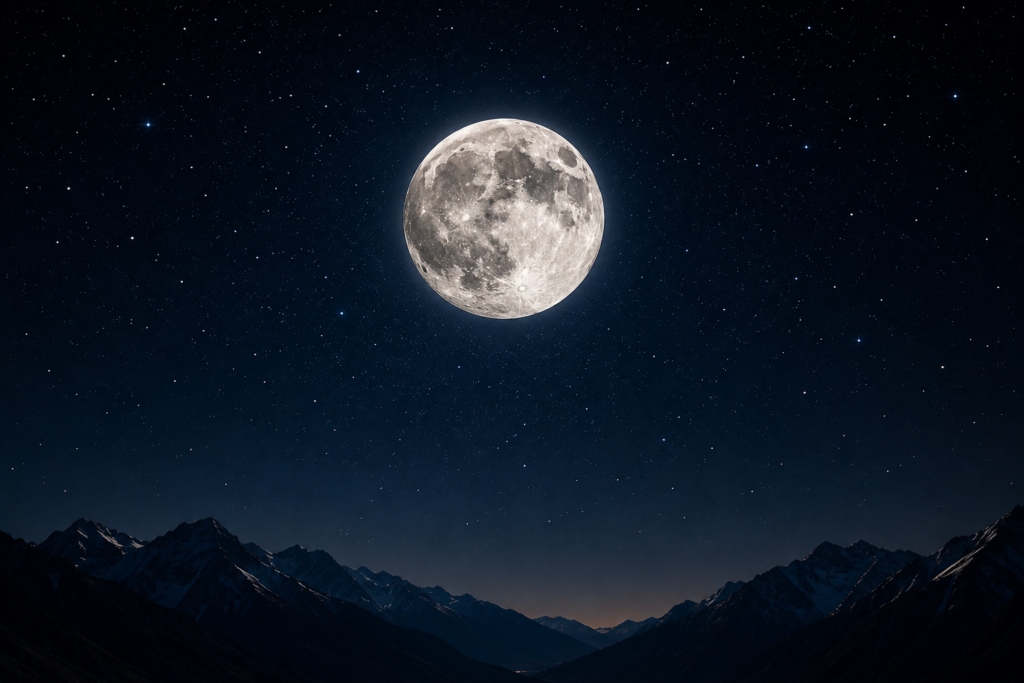
Look up at the night sky and the Moon can look a lot like a giant star. It shines brightly, it sits among thousands of other stars, and we can see it almost every night. Have you ever wondered if the moon is a star or something else? It looks so similar to thousands of other stars we see in the sky every night. Pretty easy to confuse them, they shine brightly and look like little dots. But the moon is not a star, it’s Earth’s natural satellite. It does not make its own light like the Sun and other stars. What we call moonlight is sunlight reflecting from the Moon’s surface.
The easiest way to tell the difference is to look at where their light comes from. A star makes its own light. Deep inside a star, the pressure and heat are so high that nuclear fusion takes place. This process releases huge amounts of energy in the form of light and heat. The Sun is the closest example we have. It is a star, and the light we see from the Sun comes from the energy produced inside it. The Moon works in a completely different way. It does not produce its own visible light. Instead, sunlight hits its surface and reflects back toward Earth. That reflected sunlight is what makes the Moon look bright in our sky.
But that raises a few more questions. If the Moon is not a star, what is it? Is it a planet? What actually does “satellite” mean? And what makes a star a star in the first place?
Note: Pictures in this blog post have been created with the help of Large Language Models (AI).
What Makes a Star, a Star?
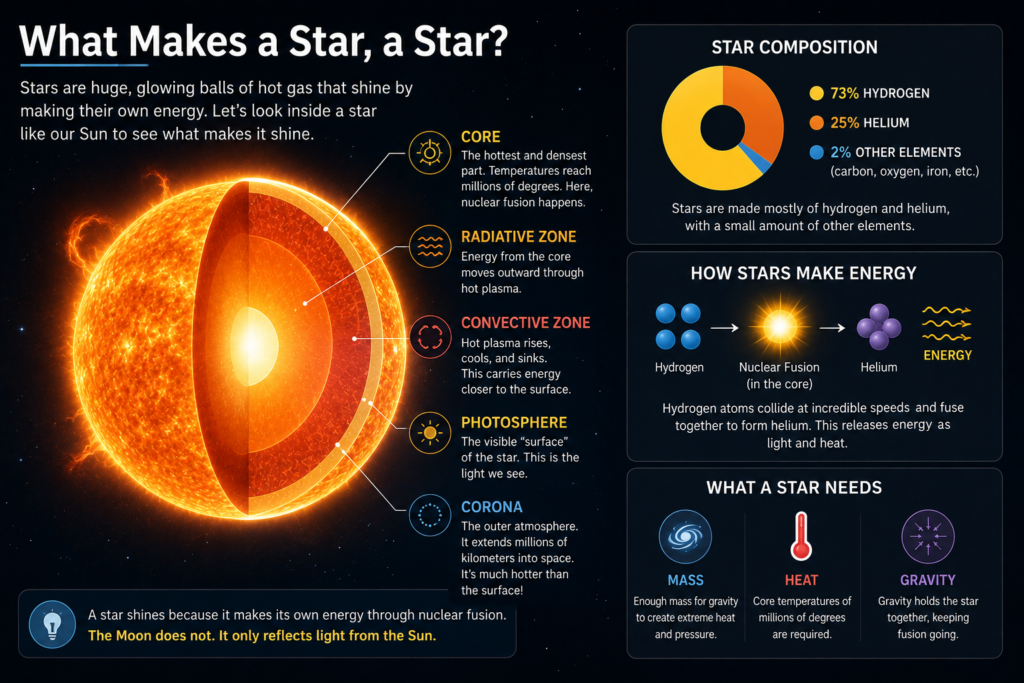
If you look at the sky in a clear day, outside of a city, you will see tons of small lights. You may think that all of those are stars but they are not. That is not really how it works. A star is a huge object made mostly of extremely hot plasma, and it has enough mass for the pressure and temperature in its core to allow nuclear fusion. The Sun is the best example because it is the closest star to us. Deep inside the Sun, hydrogen is turned into helium through nuclear fusion. This process releases enormous amounts of energy, which eventually reaches space as light and other forms of radiation. The Sun is also the only star in our Solar System.
Stars can be very different from one another because there are many different types of stars. Some are much larger than the Sun, while others are smaller. They can also have different temperatures, colors, masses, and stages of life. In the end, what matters for this conversation is that stars produce their own energy and light. The Moon does not. If you are interested about how do stars form, check this article out.
Why Does the Moon Shine if It Isn’t a Star?
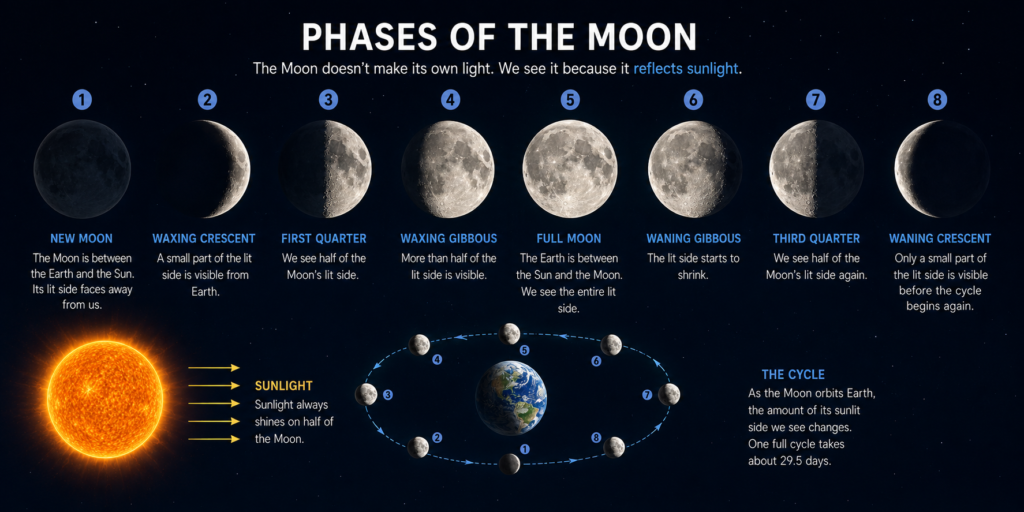
This is the part that makes the Moon seem like a star in the first place. On a clear night, the full Moon can be so bright that it lights up the ground around you. It looks as if it is producing light, but that light is actually coming from the Sun. Like I mentioned in the beginning, the Moon shines the Sun’s light. Think about a mirror in a sunny room. The mirror does not create sunlight, but it can reflect sunlight toward you. The Moon does something similar, although its surface is not nearly as reflective as a mirror. Sunlight hits the Moon and some of that light is reflected toward Earth. What we call moonlight is really reflected sunlight.
This is also one of the reasons why the Moon seems to change shape during the month. The Moon is always being lit by the Sun on one side, but as it moves around Earth, we see different amounts of that sunlit side. Sometimes we see almost the whole lit side, sometimes only a thin crescent, and sometimes almost none of it. NASA calls these changes the phases of the Moon. The Moon itself is not changing shape, and it is not switching its own light on and off. We are simply seeing different parts of the side that the Sun is lighting.
What is the Moon, then?
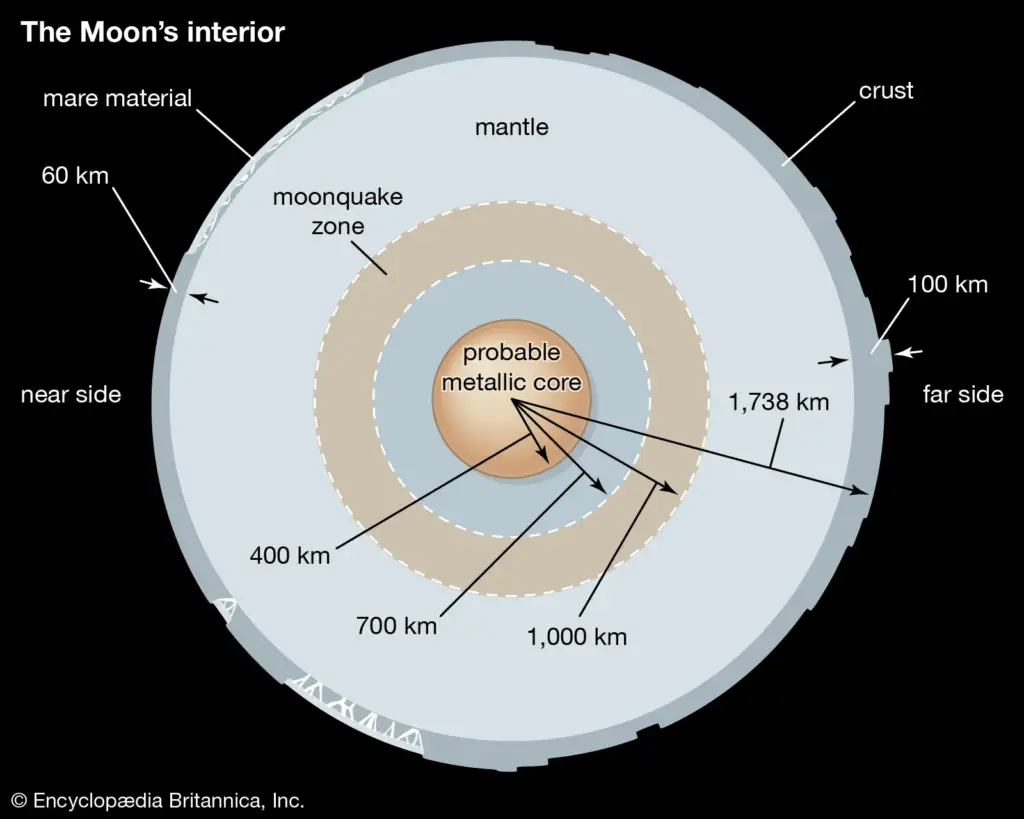
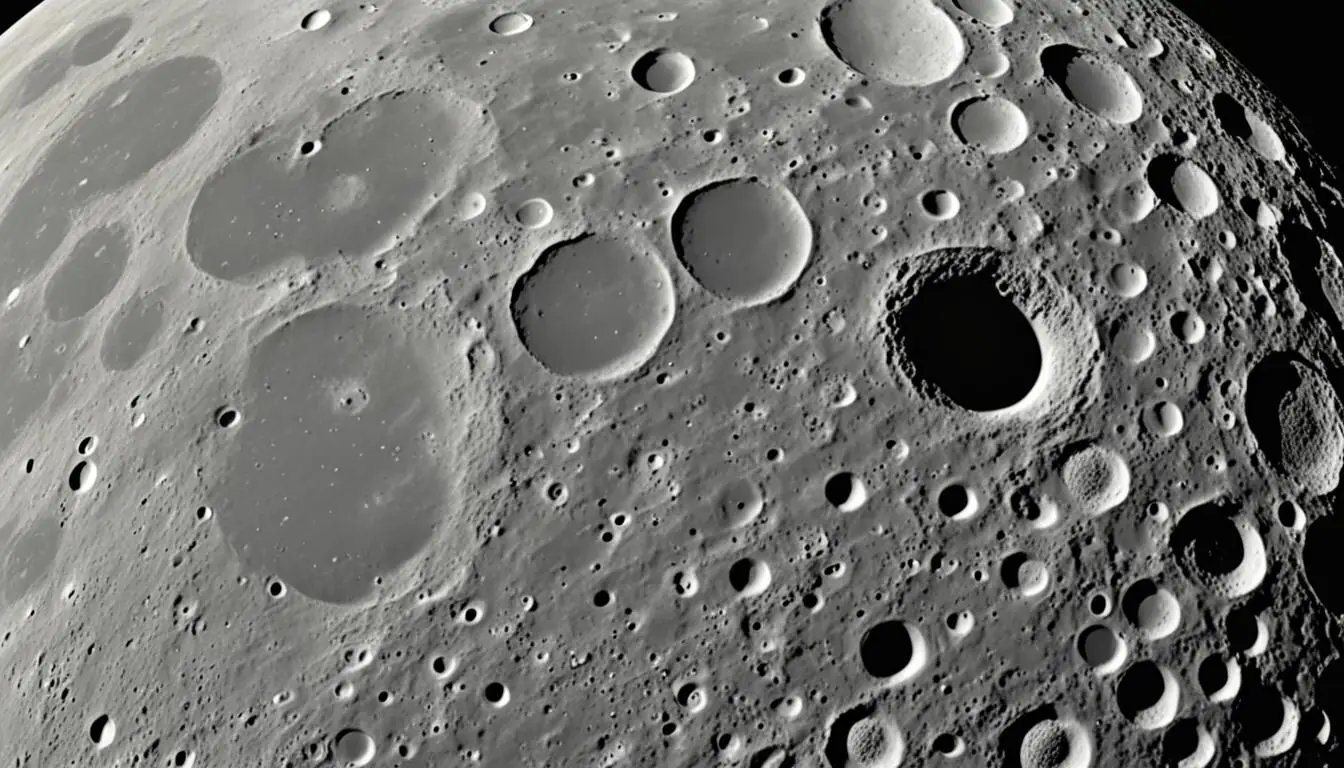
The Moon is a natural satellite of Earth. Many planets we find in the universe, including the ones in our Solar System has their own satellites. Moon is one of them. A natural satellite is a body that orbits another larger body in space. It travels around our planet at an average distance of about 384,400 kilometers. The Moon is a rocky world with a crust, mantle, and core. Its surface is covered with craters, mountains, valleys, and large areas formed by ancient volcanic activity. NASA also notes that the Moon has a very thin atmosphere called an exosphere, so it is not completely surrounded by nothing.
The Moon is much smaller than Earth, but it is still a large natural satellite. Its radius is about 1,740 kilometers, compared with about 6,371 kilometers for Earth. Actually, Moon is the largest and heaviest satellite in relation to its parent planet in our Solar System. When Pluto was classified as a planet, it was factually Charon (Pluto’s satellite) but now officially, it’s not. Although, Charon and Pluton is still there. So, technically Charon is the first one but officially, the Moon is. But by total size, Ganymede (Jupiter’s moon) is the largest moon in our Solar System.
Is the Moon a Planet?
Okay, the Moon is not a star, then is it a planet? No. The satellites of planets like Moon do not also count as a planet. They are satellites, that’s a specific term on it’s own becaue almost all planets have one, some has two, some has more. The International Astronomical Union defines a planet in our Solar System as a body that orbits the Sun, has enough mass for its gravity to make it nearly round, and has cleared its orbital neighborhood. The Moon does not meet that definition because it is a satellite of Earth rather than an independent planet orbiting the Sun. An easy to remember trio: the Sun is a star, Earth is a planet, and moon is a satellite.
Moon vs Star vs Planet
If you are new to astronomy, you may not know the exact differences between moon, star, and a planet. You now know examples of each in our Solar System but what differentiates them? From how they are formed to what they do and how they die, they are all substantially different in many aspects. Briefly, a star produces its own energy and light. A planet orbits a star, while a natural satellite orbits a planet or another larger body. The Moon therefore has a different place in the Solar System from both Earth and the Sun.
| Object | What is it? | Makes its own visible light? | What does it orbit? |
|---|---|---|---|
| Sun | Star | Yes | Center of the Milky Way |
| Earth | Planet | No | Sun |
| Moon | Natural satellite | No | Earth |
There is another difference that is worth knowing. The Moon and Earth are both rocky bodies, while the Sun is a huge ball of hot plasma made mostly of hydrogen and helium. That is why the Moon can have a solid surface covered in craters, while the Sun does not have a solid surface like Earth or the Moon. Stars, by the way, are classified by using several aspects (their size, temperature, color, and others). So Sun is is a G-Type Main Sequence Star, for example. There is an international stellar classification guide for this. Once you look at it this way, the Moon does not really resemble a star at all. It only looks similar from a great distance because both appear as bright objects in our sky.
How did The Moon Form?
The Moon has been around for about 4.5 billion years, and its story starts very early in Earth’s history. Although we do not have a concrete information on how the moon formed, we have theories (solid ones). According to NASA, the leading explanation is that a huge object collided with the young Earth. This collision sent a large amount of molten and vaporized material into space. Over time, some of that material came together under gravity and formed the Moon. This idea is usually called the giant impact hypothesis.
NASA describes the giant impact idea as the leading explanation, but there is still research into exactly how the collision happened. Scientists have considered different versions of the event, including the possibility that more than one object was involved. The Moon’s rocks have also given scientists a lot of information about its past. Apollo astronauts brought lunar rocks and soil back to Earth, and scientists are still studying them today. That’s one of the reasons why the race to the space was and is still important.
How Does the Moon Affect Earth?
Usually, the satellites of planets have big effects on their planets even though their size is not comparable to their planet’s size. The same goes for the Moon, it has a big effect on Earth. Most famous one is the ocean tides. The Moon’s gravity pulls on Earth, and this gravitational interaction is the main reason Earth’s oceans rise and fall in regular cycles. The Sun also affects the tides, but the Moon’s close distance makes its effect especially important and more effective. The Moon also affects Earth’s rotation and the long term behavior of Earth’s axis. Its presence has helped keep changes in Earth’s tilt more stable over long periods. So the Moon is not just a bright object that happens to be close to us. It is an important part of the Earth Moon system, and its gravity has been influencing our planet for billions of years.
Intriguing Facts About the Moon
The Moon is Earth’s only natural satellite and it is unusual in a few ways. For one thing, it is large compared with the planet it orbits. Earth and the Moon are also tidally locked and rotate in sync with our planet, which is why we always see the same side from Earth. Also, the Moon is slowly moving away from Earth as tidal interactions transfer energy through the Earth Moon system. NASA estimates that the Moon moves away by about 4 centimeters each year. The Moon also has no moons of its own and no rings. Its surface still carries evidence of impacts from asteroids, meteoroids, and comets, which makes it a useful record of the Solar System’s past.
FAQ
Is the Moon a star?
No, the Moon is not a star. It’s a satellite that orbits the Earth. Stars are enormous, glowing balls of gas that shine on their own.
What is the Moon made of?
The Moon has a core full of iron and minerals like Earth’s. Scientists think it came to be after Earth collided with another object billions of years ago.
How does the Moon differ from stars?
Stars are much bigger than the Moon and shine on their own. The Moon just reflects the Sun’s light. It’s a rocky body, not like the gasy stars.
Is the Moon a planet?
No, the Moon is not a planet. It’s a satellite that goes around the Earth, not the Sun. It hasn’t cleared its orbit of other objects and isn’t in balance like planets are.
What is the Moon’s role in the solar system?
The Moon is key to keeping the Earth stable and its climate right. Without it, the Earth’s tilt and wobble could change a lot, making the climate much worse.